England tenancy agreements

Rated4.8/5 | 709 reviews

HMO / Shared House Tenancy Agreement England

Use this when people are sharing the property and you need proper communal-area, house-rule, and sharer wording in the agreement.

Choose the agreement that matches how the property is actually being let.

Plain-English help, the right documents, and checks that stop avoidable mistakes before they cost you months.

  • We flag problems before you generate anything, so you do not waste time on the wrong route.
  • Answer plain-English questions and we build the documents that fit your case.
  • Preview first, fix anything that changed, and regenerate without starting from scratch.
Trusted by UK landlords

For shared houses and HMO-style lets

This route is for England lets where communal areas, sharers, and house rules need to be expressed directly in the agreement instead of being left vague or bolted onto a generic residential product.

HMO / Shared House is now a separate product. It is no longer just another name for Premium.

People often land here looking for

We keep the page easy to find using the terms landlords actually search for, then point you to the agreement that matches the let in real life.

hmo tenancy agreement englandshared house tenancy agreement englandshared accommodation tenancy agreementhmo agreement template englandroom by room tenancy agreement england

What this route covers

  • Communal-area and house-rule wording
  • Sharer-specific agreement structure
  • Separate from Premium and Student
  • Guided setup with a preview before payment

How this lines up with the current England rules

  • Built around the current England route from 1 May 2026 for the main tenancy wording.
  • Captures the fact pattern for shared houses and HMO-style occupation directly in the wizard.
  • Keeps communal-house wording separate from ordinary residential Premium drafting.
  • Use Lodger instead where the landlord lives in the property and shares the home.

This route is usually right if

  • the real complexity is communal living, sharers, visitor policy, or HMO-style management
  • you want separate wording for communal areas, house rules, fire-safety notes, and shared-house cleaning arrangements
  • you want shared-house wording without pretending the product is just Premium residential drafting

Pick a different route if

  • the landlord is resident and the occupier is sharing the home as a lodger
  • the let is an ordinary whole-property residential tenancy and does not need communal-area controls
  • the real issue is a student-focused household with guarantors and end-of-term turnover rather than HMO management

What you get

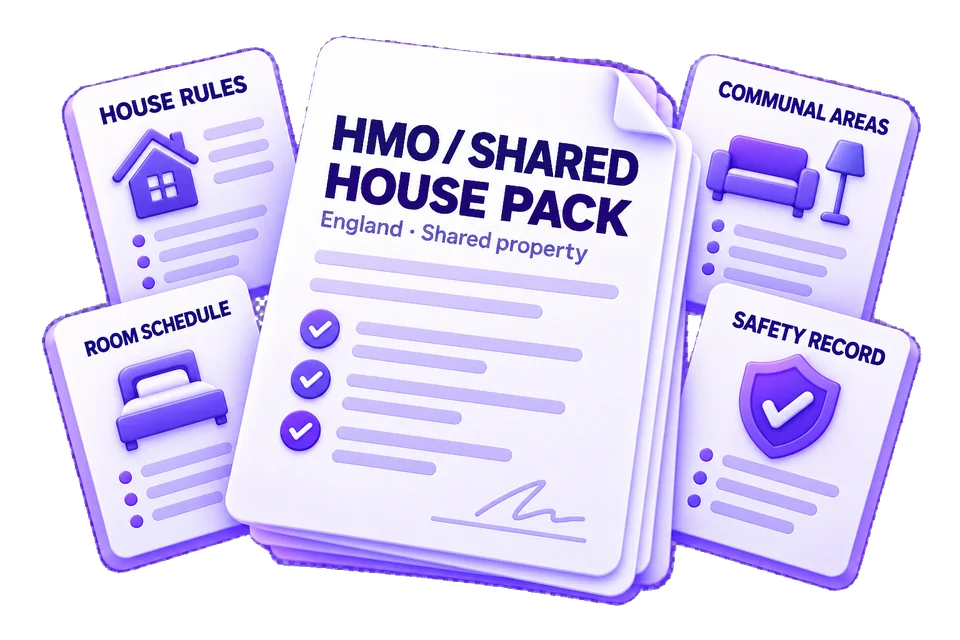
The agreement is the main document, but we also include the practical paperwork a landlord usually needs around it.

HMO / Shared House Tenancy Agreement

15-24 pages

HMO / Shared House Tenancy Agreement for the modern England assured-tenancy regime.

HMO / Shared House Rules Appendix

4-7 pages

Shared-house appendix covering communal areas, cleaning, waste, visitors, quiet hours, and fire-safety notes.

Keys & Handover Record

3-5 pages

Practical handover record for keys, access devices, and move-in confirmations.

Utilities & Meter Handover Sheet

3-5 pages

Record for utilities responsibility, opening readings, and account handover notes.

Tenancy Variation Record

3-5 pages

Simple record for agreed changes or management updates after the agreement is issued.

Compare England agreement routes

Pick the route that matches the way the property is actually being let. That matters more than old AST language or a vague idea of what sounds more "premium".

Premium Tenancy Agreement

Premium is now a separate ordinary-residential product and should not be used as shorthand for HMO complexity.

Compare Premium

Student Tenancy Agreement

Use Student if the specialist issue is student sharers, guarantors, and end-of-term return expectations.

Compare Student

Room Let / Lodger

Use Lodger where the landlord lives in the property and the arrangement is a resident-landlord room let.

Compare Lodger

England tenancy agreement FAQs

Straight answers on which England agreement to use, what it includes, and how it fits the current rules.

No. HMO / Shared House is now its own England product with its own routing and drafting, separate from Premium.
Not by default. Use Premium for fuller ordinary-residential drafting. Use the HMO / Shared House route where communal areas, sharers, or HMO-style setup are the real issue.
That is usually a Lodger / resident-landlord route rather than the HMO / Shared House tenancy path, so compare it against the Lodger product.

Choose the England agreement that fits the let

Use the HMO / Shared House route when the real complexity is communal sharers and shared-house management. Premium remains a separate ordinary residential product.