
Rated4.8/5 | 2986 reviews
Standard Tenancy Agreement After 1 May 2026
England landlord guide to using a standard tenancy agreement after the Renters Rights Act and the move away from old AST assumptions. Get the England steps a...
Use this guide when
You need a practical landlord answer, not just a definition
Use this page when you need to understand standard tenancy agreement after 1 may 2026 in landlord terms, check the evidence or compliance points that matter, and decide whether the next step is a guide, free tool, notice pack, court pack, tenancy agreement, rent increase pack, or money claim route.
You are setting up a new tenancy and you do not want to rely on an old template. This guide explains which agreement you need and what to sort before the tenant moves in.
For landlords under pressure
Why this matters now
If you are granting a straightforward let, the worry is whether the old AST template you used before still says the right things.
The practical risk is simple: if you rely on paperwork written for the old landscape, you can look organised while leaving a tenant, adviser, judge, or tribunal with an avoidable point to attack. The safer approach is to start with the route that matches the job in front of you, then keep dates, documents, evidence, and next steps in one clear file.
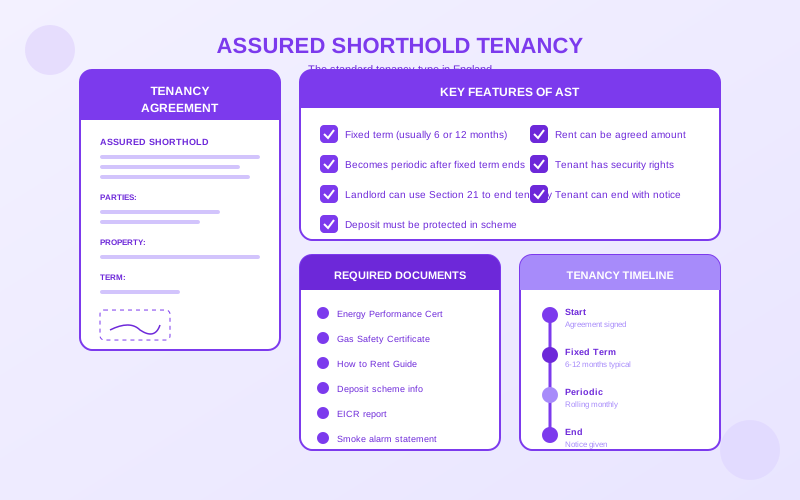
What changed after 1 May 2026
From 1 May 2026, landlords should be careful with old assured shorthold tenancy assumptions and fixed-term wording when setting up England private rented sector paperwork.
Current England agreement
Need a clean standard tenancy agreement?
Use the standard route for straightforward England lets where old AST-first wording or a generic template may no longer be the right fit.
- Built for straightforward England tenancies.
- Avoids stale fixed-term AST assumptions.
- Preview the completed agreement pack before payment.

The reform is not just a wording update. For landlords, it changes the assumptions behind the document journey. Section 21 is no longer the live route for new private rented sector possession cases in England. Assured shorthold tenancy language has to be treated carefully. Rent increase paperwork must be capable of standing up to challenge. Court-bound eviction files need the notice, evidence, and claim paperwork to tell the same story.
Product choice matters. A landlord who only needs a notice should not be forced through a court pack. A landlord already expecting court should not treat the notice as an isolated form. A landlord increasing rent needs more than a blank Form 4A if the proposed figure could be questioned. A landlord granting a new tenancy needs wording that fits the current England framework, not a stale document copied from a pre-reform file.
What can go wrong if you ignore this?
A stale agreement can create confusion about status, notices, rent, responsibilities, and the landlord file you may need later.
How this product is aligned
The Standard Tenancy Agreement route is designed for straightforward England lets where the landlord needs current wording without unnecessary complexity.
Landlord Heaven is not positioning this as a generic download. The guided route asks for the facts that matter, turns those answers into product-specific documents, and keeps the landlord focused on the next legal step. The aim is to reduce panic, reduce rework, and avoid the common mistake of treating a changed legal process as if it were still the same form with a new date on it.
Built for straightforward single-household lets.
Avoids old fixed-term AST assumptions where they no longer fit.
Keeps the setup simple without stripping out essential protections.
Built to lead landlords from confusion into a clear, product-specific action.
What you get in the pack
The point of the pack is not just to produce a document. It is to help the landlord make a cleaner decision, keep a better record, and understand what should happen next. For this product, that means:
- Current England tenancy agreement route.
- Core landlord and tenant obligations.
- Property, rent, deposit, and occupation details.
- Plain-English guided answers and document preview.
Landlords are often acting under pressure and may be relying on old templates or advice written before the Renters Rights Act changed the rules. Check the current position first, then prepare paperwork that matches the case you are dealing with.
The safest next step
Choose this route for a straightforward England tenancy where you need a clean current agreement without premium complexity.
Use Premium where the let is higher risk, more complex, guarantor-backed, shared, student-led, or where broader drafting is worth having.
If you are not sure whether your current paperwork is safe, do not wait until the tenant challenges it. Start with the correct product route, answer the questions carefully, and preview the documents before you commit. That is a better position than downloading a document in isolation and hoping it still fits the rules.
Problem identified
Use Standard Tenancy Agreement to solve it
Create the standard England agreement. You can preview the route before payment and keep your answers aligned with the current England landlord action route.
Create the standard England agreementFAQ
Do I need a new standard agreement after 1 May 2026?
It depends on the facts, but the important point is that the Renters Rights Act changed the England paperwork landscape. If you are using old wording or a generic template, check it before relying on it.
When is the Standard Tenancy Agreement enough?
Choose this route for a straightforward England tenancy where you need a clean current agreement without premium complexity.
When should I choose Premium instead?
Use Premium where the let is higher risk, more complex, guarantor-backed, shared, student-led, or where broader drafting is worth having.
What to do next
Core eviction guides landlords usually need next
These are the core possession guides landlords usually need after notice or arrears problems start.
FAQs for landlords
Official Sources & References
This guide references official legislation and government resources. Always verify current requirements with the relevant authorities.
- GOV.UK guide to the Renters Rights ActGovernmenthttps://www.gov.uk/government/publications/guide-to-the-renters-rights-act/guide-to-the-renters-rights-act
- The Renters Rights Act Information Sheet 2026Governmenthttps://www.gov.uk/government/publications/the-renters-rights-act-information-sheet-2026
- Renters Rights Act 2025Legislationhttps://www.legislation.gov.uk/ukpga/2025/26

Have a landlord question?
Ask Heaven is our free AI assistant that can help with eviction advice, tenancy questions, and more.