
Rated4.8/5 | 3008 reviews
AST Guide England | Legacy Search Explainer
England landlords still search for AST agreements, but from 1 May new agreements generally move into the assured periodic framework. This guide explains what...
Use this guide when
You need a practical landlord answer, not just a definition
Use this page when you need to understand assured shorthold tenancy in landlord terms, check the evidence or compliance points that matter, and decide whether the next step is a guide, free tool, notice pack, court pack, tenancy agreement, rent increase pack, or money claim route.
You are setting up a new tenancy and you do not want to rely on an old template. This guide explains which agreement you need and what to sort before the tenant moves in.
England only
This article is for England. Wales uses Occupation Contracts, Scotland uses Private Residential Tenancies, and Northern Ireland uses its own Private Tenancy Agreementstructure. The wording is not interchangeable.
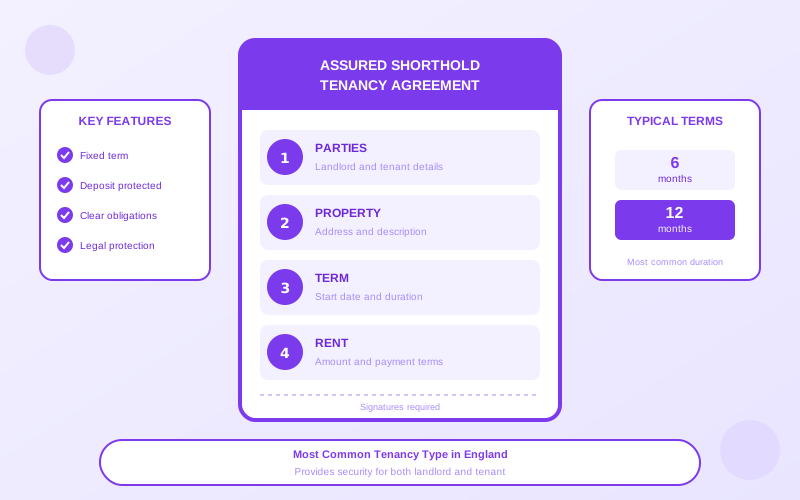
Why Landlords Still Search for AST Agreements
AST terminology has been used for years, so landlords still search for it when they want to create a new tenancy agreement, review old paperwork, or compare templates. Search behaviour does not change overnight. That is why AST pages should remain live as legacy search explainers.
New tenancy
Setting up a tenancy? Choose the right agreement
If the next job is getting the tenancy in place, choose the agreement route that matches the property and arrangement now.
- Choose the right England agreement route for the tenancy you are setting up.
- Avoid old wording that causes problems later.
- Preview it before you pay.

What should change is the sales story. A landlord looking for an AST agreement in 2026 is usually trying to solve a broader problem: they want wording that reflects the current England position, uses the right structure for the tenancy they are granting, and does not lean on clauses or assumptions that may now be out of date.
What Changed on 1 May 2026
From 1 May 2026, existing assured shorthold tenancies in England move into the assured periodic model, and new private rented sector agreements are generally framed around that same assured periodic structure. That means landlords should be careful about relying on old fixed-term AST wording as if nothing has changed.
| Search language | Current explanation |
|---|---|
| AST agreement | Legacy search term that many landlords still use when they really mean a current England tenancy agreement. |
| Fixed-term AST template | No longer the right default way to sell a new England agreement after 1 May 2026. |
| England tenancy agreement | Stronger current-language description for new England agreements designed around the assured periodic framework. |

When Old Wording May Be Outdated
An older agreement is not automatically worthless, but it may no longer reflect the current legal position, may still assume an older fixed-term AST structure, and may contain clauses a landlord expects to help later but which do not work as cleanly as expected. That becomes more important when the tenancy turns difficult.
Risk check for landlords
- Your agreement still assumes a classic fixed end date AST approach.
- Your template was downloaded years ago and only lightly edited.
- The wording was built for the wrong UK jurisdiction.
- You are relying on broad clauses that may be harder to use or explain later.
Should You Use Standard or Premium?
The real choice for many landlords is no longer "AST or not." It is whether the tenancy is straightforward enough for the Standard agreement route, or whether the property and tenant profile justify the Premium agreement route.
Standard
Usually the right fit for straightforward lets where the landlord wants current England wording without extra complexity.
Premium
Better where the let is more complex, higher-risk, shared, student-led, guarantor-backed, or where the landlord wants broader drafting and extra practical protection.
England Only: Do Not Reuse Across the UK
One of the most common landlord mistakes is assuming a generic UK template will do for every property. That is risky. Wales, Scotland, and Northern Ireland all use different tenancy frameworks, notice systems, and terminology. A document drafted for England may be the wrong starting point elsewhere.
FAQ
Is AST still the right main term for new England agreements?
It is still important legacy search language, but it is no longer the best main way to describe new England agreements after 1 May 2026.
Does every landlord need a brand-new agreement immediately?
Not always, but many landlords should review what they are using. If the wording is old, generic, or built around outdated assumptions, it may be time to replace it.
Where should I start if I want the current England route?
Use the Landlord Heaven tenancy agreement pageto compare the current Standard and Premium routes.
What to do next
Core eviction guides landlords usually need next
These are the core possession guides landlords usually need after notice or arrears problems start.
FAQs for landlords
Official Sources & References
This guide references official legislation and government resources. Always verify current requirements with the relevant authorities.
- GOV.UK tenancy agreements overviewGovernmenthttps://www.gov.uk/guidance/renting-out-your-property-guidance-for-landlords-and-letting-agents/tenancy-agreements-overview
- GOV.UK tenancy typesGovernmenthttps://www.gov.uk/guidance/renting-out-your-property-guidance-for-landlords-and-letting-agents/tenancy-types

Have a landlord question?
Ask Heaven is our free AI assistant that can help with eviction advice, tenancy questions, and more.