
Rated4.8/5 | 3008 reviews
How to Write Particulars of Claim - Rent Arrears (England 2026)
Learn how to write effective particulars of claim for rent arrears cases. Step-by-step guide with examples for County Court money claims against tenants.
Use this guide when
You need a practical landlord answer, not just a definition
Use this page when you need to understand particulars of claim rent arrears in landlord terms, check the evidence or compliance points that matter, and decide whether the next step is a guide, free tool, notice pack, court pack, tenancy agreement, rent increase pack, or money claim route.
Your tenant owes you money and you need to know the fastest lawful way to chase it. This guide explains the route, the paperwork, and the mistakes that can slow you down.
What You'll Learn
- The essential elements every particulars of claim must include
- Templates for rent arrears, property damage, and combined claims
- How to claim interest correctly
- Common mistakes that can undermine your case

What Are Particulars of Claim?
Particulars of claim are a formal document that explains to the court (and the defendant) why you are owed money. They must set out:
Unpaid rent
Tenant still owes money? Prepare the claim file
If the arrears keep growing, turn the problem into a clearer debt record and claim narrative before the evidence gets harder to untangle.
- Set out what is owed clearly before the numbers get harder to untangle.
- Build the claim in plain English.
- Get the court paperwork ready for the next step.

- The facts that give rise to the claim
- The legal basis for your claim
- What you are claiming and how much
For money claims through money claim for unpaid rent, the particulars are entered into an online form with a character limit. You must be concise while including all essential information.
The Purpose
Good particulars achieve several things:
- Inform the defendant: They need to understand the case against them
- Assist the court: The judge needs to know what the dispute is about
- Focus the issues: Clear particulars help identify what is (and isn't) disputed
- Enable judgment: If the defendant doesn't respond, the court can enter judgment based on your particulars
Key Elements to Include
Every particulars of claim for a landlord-tenant money dispute should include:
Essential Elements Checklist:
- 1Identity of parties:
Who is the claimant (landlord) and who is the defendant (tenant)?
- 2The property:
Full address of the rental property
- 3The tenancy:
Type of tenancy, start date, and key terms (especially rent amount and due date)
- 4The breach:
What the defendant did (or failed to do) that gives rise to the claim
- 5The amount:
How much is owed and how it was calculated
- 6Demand for payment:
That you have demanded payment and the defendant has failed to pay
Rent Arrears Example
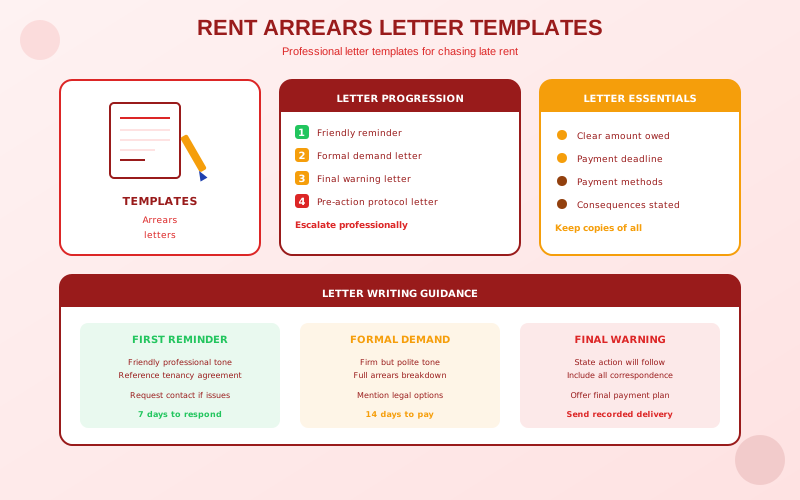
Here is a template for a straightforward rent arrears claim. Adapt it to your specific circumstances:
1. The Claimant is and was at all material times the landlord of the property known as [FULL ADDRESS INCLUDING POSTCODE] ("the Property").
2. By a written Assured Shorthold Tenancy agreement dated [DATE], the Claimant let the Property to the Defendant for a term of [LENGTH, e.g., 12 months] commencing on [START DATE].
3. Under the tenancy agreement, the Defendant agreed to pay rent of £[AMOUNT] per calendar month, payable in advance on the [DAY] of each month.
4. The Defendant failed to pay rent as follows:
- [DATE]: £[AMOUNT] due, unpaid
- [DATE]: £[AMOUNT] due, unpaid
- [Continue for each missed payment]
5. The total rent arrears as at [DATE] amount to £[TOTAL].
6. The tenancy ended on [DATE]. Despite written demand dated [DATE], the Defendant has failed to pay the arrears.
7. The Claimant claims:
- (a) £[AMOUNT] being rent arrears;
- (b) Interest pursuant to [section 69 of the County Courts Act 1984 / the tenancy agreement] at [RATE]% per annum;
- (c) Costs.
Property Damage Example
For claims where the tenant caused damage beyond normal wear and tear:
1. The Claimant is the landlord of [ADDRESS] ("the Property").
2. By a written Assured Shorthold Tenancy dated [DATE], the Property was let to the Defendant from [START DATE] to [END DATE].
3. Under clause [NUMBER] of the tenancy agreement, the Defendant agreed to keep the Property in good condition, not to cause damage, and to return the Property at the end of the tenancy in the same condition as at the start (fair wear and tear excepted).
4. At the start of the tenancy, an inventory was prepared recording the condition of the Property. At the end of the tenancy, a check-out report was prepared on [DATE].
5. In breach of the tenancy agreement, the Defendant caused or permitted the following damage to the Property:
- (a) [Description of damage] - Cost of repair/replacement: £[AMOUNT]
- (b) [Description of damage] - Cost of repair/replacement: £[AMOUNT]
- (c) Professional cleaning required due to condition: £[AMOUNT]
6. The total cost of making good the damage is £[TOTAL].
7. A security deposit of £[AMOUNT] was held. After deduction of agreed amounts, the Defendant owes an additional £[AMOUNT].
8. Despite demand dated [DATE], the Defendant has failed to pay.
9. The Claimant claims £[AMOUNT], interest, and costs.
Combined Arrears and Damage
If you are claiming both rent arrears and damage, combine the elements:
1. The Claimant is the landlord of [ADDRESS] ("the Property").
2. By a written Assured Shorthold Tenancy dated [DATE], the Property was let to the Defendant from [START DATE]. The tenancy ended on [DATE].
3. Under the tenancy agreement, the Defendant agreed to pay rent of £[AMOUNT] per month on the [DAY] of each month.
4. The Defendant also agreed to keep the Property in good condition and return it at the end of the tenancy in the same condition as at the start.
RENT ARREARS
5. The Defendant failed to pay rent from [DATE] to [DATE], totalling £[AMOUNT].
DAMAGE
6. In breach of the tenancy agreement, the Defendant caused the following damage: [Brief description]. The cost of repair is £[AMOUNT].
7. A deposit of £[AMOUNT] was held. After deducting [WHAT], the balance owed is £[AMOUNT].
8. Despite demand, the Defendant has not paid.
9. The Claimant claims £[TOTAL], interest, and costs.
Common Mistakes to Avoid
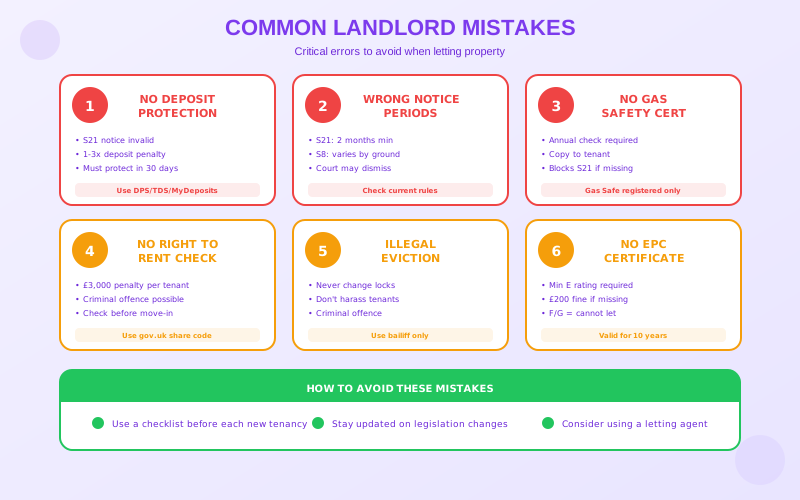
Critical Errors
- Wrong defendant: Make sure you sue the right person - check the tenancy agreement for the correct name
- No figures: You must state specific amounts, not vague claims
- Missing dates: Include dates for the tenancy, breaches, and demands
- Exaggeration: Only claim what you can prove - inflated claims damage credibility
Other Common Problems
- Too much detail: Be concise. Save the full evidence for later.
- Legal jargon: Plain English is better than Latin phrases
- Missing the contract: You must establish there was a tenancy agreement
- No demand: Show you asked for payment before suing
- Wrong interest rate: Check whether contractual or statutory interest applies
- Claiming deposit incorrectly: If you're claiming damages, explain what the deposit covered
Claiming Interest
You can claim interest on money owed. There are two options:
Contractual Interest
If your tenancy agreement specifies an interest rate for late payment, you can claim at that rate. Quote the relevant clause in your particulars.
Statutory Interest
If the contract doesn't specify interest, you can claim under section 69 of the County Courts Act 1984 at 8% per year simple interest.
Calculating Interest
Interest at 8% per year = 0.022% per day.
Example: £5,000 debt for 90 days = £5,000 × 0.00022 × 90 = £99 interest.
State in your particulars: "Interest at 8% per annum from [DATE] to [DATE] = £[AMOUNT], and continuing at £[DAILY RATE] per day until judgment."
Particulars of Claim FAQ
How long should particulars of claim be?
For MCOL, you're limited to 1,080 characters (about 150-200 words). Be concise. You can attach a longer document if needed, but the basics should fit in the form. For paper claims, 2-3 pages is normal for a straightforward rent arrears case.
Do I need to attach evidence?
Not at the particulars stage. You're just setting out your claim. Evidence (tenancy agreement, rent records, photos) comes later if the defendant disputes the claim. Keep your evidence ready.
Can I amend my particulars later?
Yes, but it requires court permission after certain stages. It's better to get them right first time. If you need to amend, apply promptly - late amendments may not be allowed.
Should I use a solicitor?
For straightforward rent arrears under £10,000, you can handle it yourself. The small claims track is designed for litigants in person. For larger or complex claims, legal advice may be worthwhile.
What if I make a mistake?
Minor errors (typos, wrong dates) can usually be corrected. Fundamental errors (wrong defendant, wrong amount) are more serious. If in doubt, withdraw and reissue the claim - this is usually possible early on.
What about jointly liable tenants?
If multiple tenants signed the tenancy, they are usually jointly and severally liable. You can sue all of them, or any one of them for the full amount. State in your particulars that they are jointly liable.
Get Professional Templates
Landlord Heaven's Money Claim Pack includes professionally drafted particulars of claim templates for rent arrears, property damage, and combined claims - plus letters before action and enforcement guidance.
View Money Claim Pack ?Prefer us to prepare it with you?
Free consultation before any assisted eviction preparation is agreed
We discuss the facts first. If we can help, we confirm the scope and send a secure Stripe payment link afterwards.
Unsure about grounds or dates?
Landlord Section 8 notice assistance
Free consultation · £149.00 only if we confirm we can help
Before you serve, we help organise your Form 3A, tenant details, notice timing, service plan and evidence prompts around the facts you approve.
Book free consultation
Want the full case, including court forms?
Landlord eviction assistance service
Free consultation · £399.00 only if we confirm we can help
Our £399 full-case service can cover your Section 8 notice, service record, N5, N119 particulars of claim and supporting bundle. If you have already served notice, we focus on the court-stage pack.
Book free consultationWhat to do next
Core eviction guides landlords usually need next
These are the core possession guides landlords usually need after notice or arrears problems start.
FAQs for landlords
Official Sources & References
This guide references official legislation and government resources. Always verify current requirements with the relevant authorities.
- Practice Direction 16 - Statements of CaseOfficialhttps://www.justice.gov.uk/courts/procedure-rules/civil/rules/part16/pd_part16
- Form N1: Claim form (CPR Part 7)Governmenthttps://www.gov.uk/government/publications/form-n1-claim-form-cpr-part-7
- County Courts Act 1984, section 69Legislationhttps://www.legislation.gov.uk/ukpga/1984/28/section/69

Have a landlord question?
Ask Heaven is our free AI assistant that can help with eviction advice, tenancy questions, and more.