
Rated4.8/5 | 3008 reviews
Section 8 Ground 8 Explained: Mandatory Rent Arrears Eviction (2026)
Complete guide to Section 8 Ground 8 for rent arrears eviction in England. Learn the post-May arrears threshold, how to prove arrears, court procedures, and...
Assisted prep
Need help preparing your Section 8 notice?
Start with a free consultation. If suitable, we can help prepare the Form 3A notice, service record and supporting evidence before you serve it.
Book free consultationUse this guide when
You need a practical landlord answer, not just a definition
Use this page when you need to understand section 8 ground 8 in landlord terms, check the evidence or compliance points that matter, and decide whether the next step is a guide, free tool, notice pack, court pack, tenancy agreement, rent increase pack, or money claim route.
Your tenant owes rent and you need to know whether a Section 8 notice guide notice is the right move. This guide explains how it works, what can trip you up, and what to do next.
What landlords should do next
If you are under pressure, decide the route early. In England after 1 May 2026, Section 21 is no longer the live route for new cases. If this ground fits, the next step is using the current Form 3A process with the right evidence and timing.
Need to act on an England possession ground now?
For post-1 May 2026 England cases, Section 21 has gone and the live route is the Form 3A possession notice. Choose the product that matches how far the case has gone.
- Eviction Notice Generator for the Form 3A notice, service instructions, validity checklist, compliance declaration, and arrears statement before you serve anything.
- Complete Eviction Pack if you want the notice, N5, N119, evidence checklist, witness material, and possession file working together from the start.
- Section 8 guide if you want the rule overview first.
- Ground-specific guides: Ground 1 occupation, Ground 1A sale, Ground 2 mortgagee sale, Ground 7A serious ASB, Ground 8 arrears, Ground 10 arrears, Ground 11 late rent, Ground 12 breach, Ground 13 property deterioration, Ground 14 ASB, Ground 15 furniture, and Ground 17 false statement.
Why Ground 8 Is So Powerful
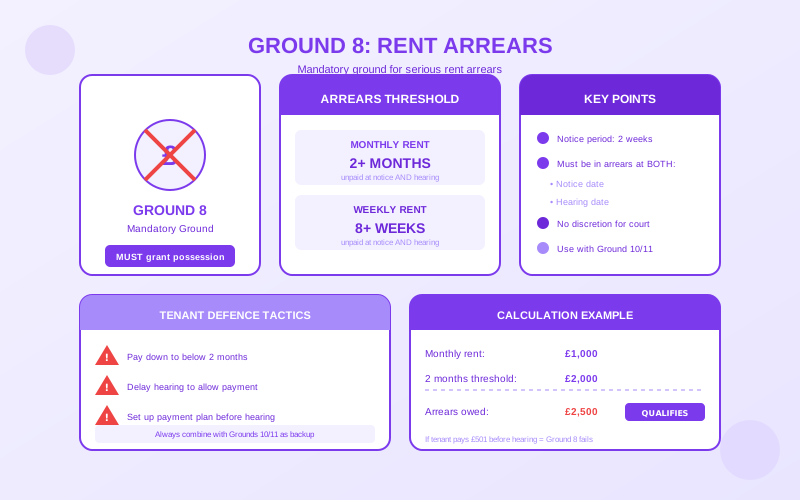
Unlike discretionary grounds where judges can refuse possession based on the tenant's circumstances, Ground 8 is mandatory. If you meet the threshold at both dates, the court has no choice but to order possession. The tenant's personal situation, no matter how sympathetic, cannot prevent the order.
What Is Ground 8?
Ground 8 is found in Schedule 2 of the Housing Act 1988. It states that possession is mandatory where:
Unpaid rent
Tenant still owes money? Prepare the claim file
If the arrears keep growing, turn the problem into a clearer debt record and claim narrative before the evidence gets harder to untangle.
- Set out what is owed clearly before the numbers get harder to untangle.
- Build the claim in plain English.
- Get the court paperwork ready for the next step.

"Both at the date of the service of the notice... and at the date of the hearing—
(a) if rent is payable weekly or fortnightly, at least 13 weeks' rent is unpaid;
(b) if rent is payable monthly, at least three months' rent is unpaid;
(c) if rent is payable quarterly, at least one quarter's rent is more than three months in arrears;
(d) if rent is payable yearly, at least three months' rent is more than three months in arrears."
For most landlords with monthly rent payments, this means the tenant must owe at least 3 full months' rent on two specific dates: when you serve the Form 3A notice, and when the case is heard in court.
Key Features of Ground 8
- Mandatory: Court must grant possession if threshold met
- Two-date test: Arrears must exist at notice date AND hearing date
- 4-week notice period: The current post-May 2026 England notice period for Ground 8
- No reasonableness test: Tenant circumstances are irrelevant
- Can be combined: Often used alongside Grounds 10 and 11
Requirements for Ground 8
To successfully use Ground 8, you must satisfy these conditions:
1. The Arrears Threshold
For monthly tenancies, the tenant must owe at least 3 full months' rent. This is calculated as:
- If monthly rent is £1,000, they must owe at least £3,000
- If monthly rent is £1,500, they must owe at least £4,500
- Partial months don't count—£2,999 on a £1,000/month rent is NOT 3 months
2. The Two-Date Rule
This is where many landlords lose Ground 8. The 3-month / 13-week threshold must be met on:
- Date 1: When you serve the Form 3A notice
- Date 2: When the step-by-step UK eviction process takes place
If the tenant pays down below the Ground 8 threshold at any point between these dates, they can pay back up above the threshold by the hearing—but many don't. Tenants who understand the system often pay just enough to defeat Ground 8.
Critical Warning
If the monthly rent is £1,000 and the tenant owes £3,050 but pays £100 before the hearing, leaving £2,950 owed, you lose Ground 8. This is why we recommend always including Grounds 10 and 11 as backup—they're discretionary but don't have the strict threshold.
Calculating Rent Arrears
Accurately calculating arrears is crucial. Courts will scrutinise your figures, and errors can undermine your case.
What Counts as "Rent"
- Yes: The contractual rent amount specified in the tenancy agreement
- No: Late payment fees, admin charges, or penalties
- Maybe: Service charges (depends on the tenancy agreement wording)
Example Calculation
| Month | Rent Due | Paid | Running Total Owed |
|---|---|---|---|
| September 2025 | £1,200 | £1,200 | £0 |
| October 2025 | £1,200 | £600 | £600 |
| November 2025 | £1,200 | £0 | £1,800 |
| December 2025 | £1,200 | £0 | £3,000 |
In this example, with £1,200/month rent, the Ground 8 threshold is £3,600. The tenant would need to owe at least that amount at both the notice date and the hearing for Ground 8 to apply.
The Ground 8 Process
Step-by-Step
- Verify arrears meet the post-May 2026 threshold - Calculate precisely using your rent ledger
- Serve Form 3A - Citing Ground 8 (and Grounds 10, 11 as backup)
- Wait 4 weeks - The minimum notice period for Ground 8
- Apply to court - Using Form N5 and N119, pay £355 fee
- Prepare evidence - Rent ledger, tenancy agreement, bank statements
- Attend hearing - Present evidence, confirm arrears still meet the Ground 8 threshold
- Obtain possession order - Usually 14 days for the tenant to leave
Timeline
| Stage | Duration |
|---|---|
| Notice period | 4 weeks (minimum) |
| Court processing | 4-8 weeks |
| Possession order compliance | 14-28 days |
| Bailiff (if needed) | 4-6 weeks |
| Total | 3-5 months |
Evidence You Need
At the hearing, you'll need to prove the arrears threshold is met. Bring:
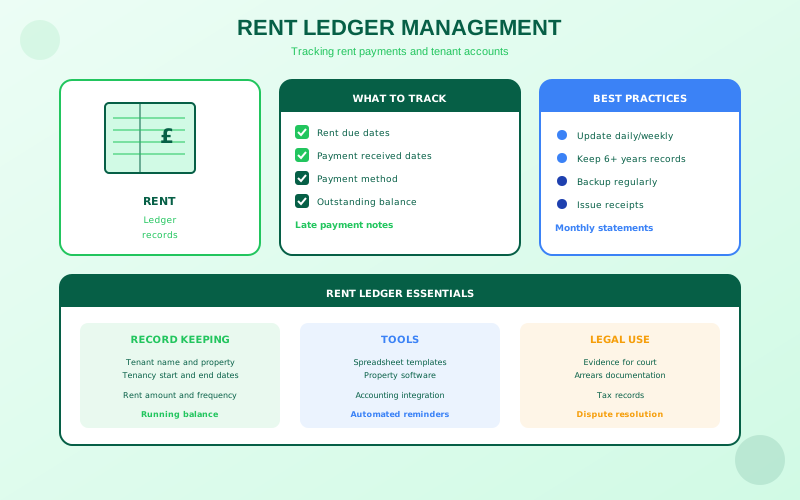
- Rent ledger: Showing all rent due and payments received, with running balance
- Tenancy agreement: Confirming the rent amount and payment dates
- Bank statements: Corroborating the payment (or non-payment) record
- Section 8 notice: Copy of the notice you served
- Proof of service: Recorded delivery receipt, witness statement, or photos
- Updated arrears figure: Calculate up to the hearing date
Common Tenant Tactics
Tenants (or their advisors) may try various tactics to defeat Ground 8:
1. Strategic Payment
Paying just enough before the hearing to bring arrears below the Ground 8 threshold. This defeats Ground 8 but you can still pursue Grounds 10/11.
2. Disputing the Amount
Claiming they paid more than you recorded, or that some payments weren't credited. Counter this with bank statements and clear records.
3. Set-Off Claims
Arguing that repairs were needed and they withheld rent. This can reduce the effective arrears. However, for Ground 8, only actual payments count—set-off is usually argued at the reasonableness stage (which doesn't apply to mandatory grounds).
4. Adjournment Requests
Asking for more time to pay or find housing. Judges sometimes grant short adjournments, during which the tenant may try to pay down arrears.
Protect Yourself
Always use Grounds 10 and 11 alongside Ground 8. If the tenant defeats Ground 8 through strategic payment, you still have discretionary grounds. The judge will consider the persistent non-payment history when deciding reasonableness.
Alternative Grounds
When Ground 8 isn't available or as backup:
Ground 10: Some Rent Unpaid
Discretionary ground - any rent arrears at notice AND hearing date. Doesn't require the Ground 8 threshold. Court considers reasonableness.
Ground 11: Persistent Delay
Discretionary ground - tenant persistently delays paying rent, even if eventually paid. Useful for tenants who always pay late.
Read our guide to Grounds 10 and 11 ?
Ground 8 FAQ
What if the tenant pays off some arrears after I serve the notice?
If they pay down below the Ground 8 threshold at any point before the hearing, you cannot use Ground 8. However, you can still pursue Grounds 10 and 11 if included in your notice. The history of arrears will be considered for reasonableness.
Can I claim the rent arrears as well as possession?
Yes. You can include a money claim for unpaid rent for the arrears in your possession proceedings. This is more efficient than separate claims. The court can order possession AND a money judgment.
What if the tenant claims they can't afford to pay?
For Ground 8, this is irrelevant. The ground is mandatory—if the post-May 2026 arrears threshold exists at both dates, the court must grant possession regardless of the tenant's financial situation or personal circumstances.
Does Housing Benefit/Universal Credit count as payment?
Only if it's actually received. If the tenant is waiting for benefits, evict tenant not paying rent guide is still arrears. However, if benefits are paid directly to you and there's a shortfall, only the shortfall counts as arrears.
How do I calculate arrears for weekly rent?
For weekly or fortnightly rent, the threshold is 13 weeks' rent. Multiply your weekly rent by 13 to get the threshold. The same two-date rule applies: 13 weeks must be owed at notice date and hearing date.
Create Your Section 8 Notice
Create a Section 8 notice with Ground 8, 10, and 11 set out clearly drafted. Includes a rent arrears schedule template and hearing preparation guide.
Create Section 8 Notice ?A clearer route from ground to possession
What to prepare for Section 8 Ground 8
Keep the reason for possession, the notice, proof of service and later court evidence consistent from the outset. Choose the route that matches what you need to do next.
Match the facts
Use the ground only where your evidence supports the reason you will give.
Prepare and serve
Check the notice details, timing and service record before you send anything.
Keep the file joined up
Store the notice, service proof and supporting documents for any court stage.
Choose your document route
Start at the stage your case is actually in

Stage 1: serve the Section 8 notice
£39.99Choose this route when your immediate job is preparing Form 3A and a clear service record before anything is sent to the tenant.
- Problem it solves
- It keeps the ground, tenant details, notice date and service evidence in one notice-stage file.
- Risk if this is not the right stage
- If the tenant stays, you will still need to prepare the court claim file at the next stage.
- Landlord outcome
- You have a structured notice and service route ready to review, approve and serve yourself.

Stage 2: build the full possession file
£69.99Choose this route when you want the Section 8 notice and the court-stage forms, evidence structure and hearing prompts planned together.
- Problem it solves
- It avoids building the notice file first and then trying to reconstruct the same facts for court later.
- Risk if this is not the right stage
- If you only need to serve notice now, this may be more preparation than your case needs today.
- Landlord outcome
- You can prepare one joined-up file for notice, N5, N119, evidence and the court stage.
Prefer us to prepare it with you?
Start with a free consultation before any paid work is agreed
Tell us what has happened and show us the documents you have. We confirm whether assisted preparation is suitable, explain the scope, and only then send a secure payment link.
Section 8 notice assistance
For landlords who need the Form 3A notice, service plan and evidence prompts checked before serving.
Book a free consultation · £149.00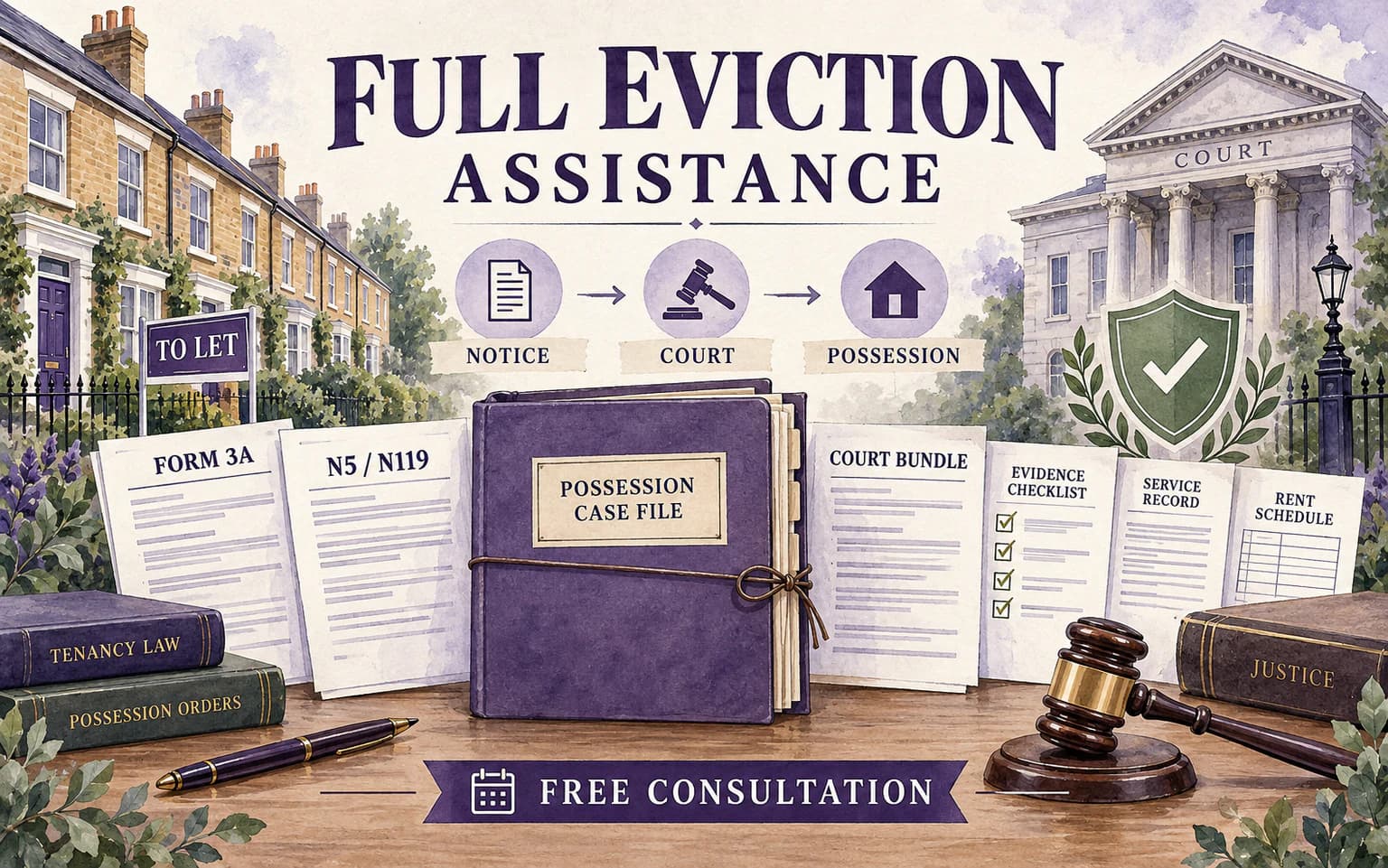
Full eviction case assistance
For landlords who want the Section 8 notice plus N5, N119, service record, evidence bundle and court-stage file prepared together.
Book a free consultation · £399.00What to do next
Core eviction guides landlords usually need next
These are the core possession guides landlords usually need after notice or arrears problems start.
FAQs for landlords

Have a landlord question?
Ask Heaven is our free AI assistant that can help with eviction advice, tenancy questions, and more.