
Rated4.8/5 | 3008 reviews
Scotland Ground 15 - Antisocial Association Eviction Guide 2026
Complete guide to Ground 15 eviction in Scotland when the tenant associates with someone who has behaved antisocially. Learn requirements and Tribunal process.

Assisted prep
Want a second pair of eyes before you act?
Book a free consultation and we will review the route and documents with you. We only confirm paid assisted preparation if we can help.
Book free consultationUse this guide when
You need a practical landlord answer, not just a definition
Use this page when you need to understand scotland ground 15 antisocial association eviction in landlord terms, check the evidence or compliance points that matter, and decide whether the next step is a guide, free tool, notice pack, court pack, tenancy agreement, rent increase pack, or money claim route.
You are setting up a new tenancy and you do not want to rely on an old template. This guide explains which agreement you need and what to sort before the tenant moves in.
Ground 15 Key Points
- Type: Discretionary ground
- Notice period: 28 days (regardless of tenancy length)
- Key requirement: Tenant associates with antisocial person at or near property
- Evidence: Antisocial behaviour evidence, association proof, impact evidence
What Is Ground 15?
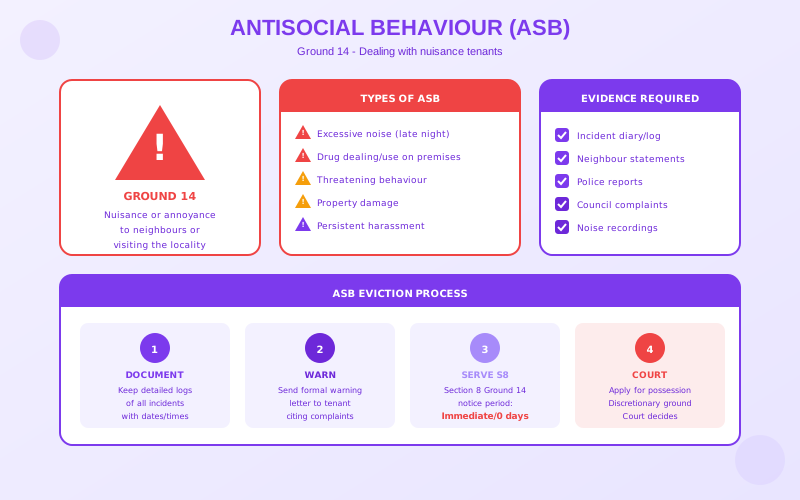
Ground 15 of Schedule 3 to the Private Housing (Tenancies) (Scotland) Act 2016 applies when the tenant associates at or near the let property with a person who has a relevant conviction or who has engaged in relevant antisocial behaviour.
New tenancy
Setting up a tenancy? Choose the right agreement
If the next job is getting the tenancy in place, choose the agreement route that matches the property and arrangement now.
- Choose the right England agreement route for the tenancy you are setting up.
- Avoid old wording that causes problems later.
- Preview it before you pay.

This ground recognises that tenants may not personally behave antisocially but may still cause problems by associating with those who do. It's often used when:
- Visitors repeatedly cause problems at the property
- The tenant allows known troublemakers to use the property
- Friends or associates of the tenant harass neighbours
- The property becomes a gathering point for antisocial individuals
This is a discretionary ground. The Tribunal must consider reasonableness even if the ground is proved.
Requirements
To use Ground 15, you must prove:
Three Key Elements:
- 1The tenant "associates" with another person
More than casual contact - a continuing relationship or regular interaction
- 2That person has relevant conviction or antisocial behaviour
Either convicted of offence at/near the property, or engaged in antisocial behaviour there
- 3The association occurs at or near the property
The association happens at or in the locality of the let property
What Is "Association"?
The legislation doesn't define association precisely, but it implies more than fleeting contact. Examples include:
- Regular visitors to the property
- Friends who spend time at or near the property
- Partners or family members who visit frequently
- People the tenant socialises with locally
Tenant's Knowledge
The Tribunal will likely consider whether the tenant knew about the person's behaviour when assessing reasonableness. A tenant who unwittingly associated with someone may have a stronger defence.
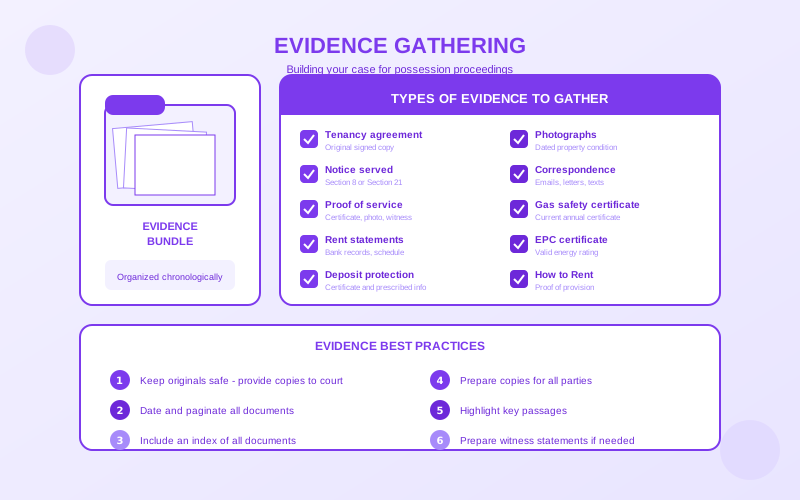
Evidence Needed
Evidence of Antisocial Behaviour or Conviction
- Conviction certificate for the associated person
- Incident logs of antisocial behaviour
- Police reports or crime references
- Neighbour witness statements
- Council antisocial behaviour team records
Evidence of Association
- Witness statements describing regular visits
- Your observations of the person at the property
- CCTV footage if available
- Records of incidents involving this person at the property
Notice Requirements
Notice Period
Ground 15 has a fixed 28-day notice period regardless of tenancy length:
| Tenancy Length | Notice Period |
|---|---|
| Any length | 28 days |
Tribunal Process
Application
After the notice expires, apply to the First-tier Tribunal with:
- Application form
- Notice to Leave and proof of service
- Tenancy agreement
- Evidence of the associate's behaviour/conviction
- Evidence of the association
- Statement on why eviction is reasonable
Reasonableness Factors
Favouring Eviction
- Serious behaviour by the associate
- Ongoing or repeated association
- Tenant refused to stop contact
- Significant impact on neighbours
- Previous warnings ignored
Against Eviction
- Tenant didn't know about the behaviour
- Association has now ended
- Tenant took steps to address the situation
- Impact on tenant's family
Ground 15 FAQ
What if the tenant ends the association?
If the tenant genuinely ends contact with the antisocial person before the hearing, this significantly affects reasonableness. The Tribunal may decide eviction is no longer reasonable.
What about family members?
Family relationships don't exempt people from Ground 15, but the Tribunal will consider this when assessing reasonableness.
How do I prove the association?
Document regular visits - dates, times, and what happened. Neighbour statements are valuable. You don't need to prove the nature of the relationship, just that regular association occurs.
Is Ground 14 easier to use?
Ground 14 covers antisocial behaviour by visitors directly. If the visitor is causing problems at the property, you might use Ground 14 instead.
Can I use Ground 15 with other grounds?
Yes. Ground 15 often works alongside Ground 14 (antisocial behaviour) or Ground 13 (criminal behaviour). Using multiple grounds can strengthen your application.
Problems With Visitors at Your Property?
Landlord Heaven provides guidance and templates for landlords dealing with antisocial behaviour from tenants' visitors and associates.
View Eviction Products ?Prefer us to prepare it with you?
Free consultation before any assisted eviction preparation is agreed
We discuss the facts first. If we can help, we confirm the scope and send a secure Stripe payment link afterwards.
Unsure about grounds or dates?
Landlord Section 8 notice assistance
Free consultation · £149.00 only if we confirm we can help
Before you serve, we help organise your Form 3A, tenant details, notice timing, service plan and evidence prompts around the facts you approve.
Book free consultation
Want the full case, including court forms?
Landlord eviction assistance service
Free consultation · £399.00 only if we confirm we can help
Our £399 full-case service can cover your Section 8 notice, service record, N5, N119 particulars of claim and supporting bundle. If you have already served notice, we focus on the court-stage pack.
Book free consultationWhat to do next
Core eviction guides landlords usually need next
These are the core possession guides landlords usually need after notice or arrears problems start.
FAQs for landlords

Have a landlord question?
Ask Heaven is our free AI assistant that can help with eviction advice, tenancy questions, and more.