Section 21 Eviction Process Explained (England, )
Step-by-step guide to the Section 21 eviction process in England. Learn the requirements, timeline, court procedures, and why you must act before May when Se...
Problem → education → solution → action
If you are dealing with this right now, use this guide to understand your options quickly, then move straight into the right landlord workflow.

Problem → solution

Need to act on this now?
- Notice, possession, and court flow in one place
- Step-by-step process from notice to filing
- Court-ready bundle outputs
The Section 21 eviction process has been the primary route for landlords in England to regain possession of their property since 1988. Also known as "no-fault" eviction, it allows you to end an Assured Shorthold Tenancy without proving any wrongdoing by the tenant. This guide walks you through every step of the process—but time is running out.
Need a compliance-checked Section 21 case file? Generate the AI-validated Section 21 eviction bundle for court-ready Form 6A paperwork.
Critical Deadline: 30 April 2026
Section 21 is being abolished on 1 May 2026. The last day to serve a valid Section 21 notice is 30 April 2026. If you may need to regain possession of any property, you must serve your notice before this date. After May 2026, you will only be able to evict using Section 8, which requires proving specific grounds.

Section 21 Overview
Section 21 of the Housing Act 1988 gives landlords the right to recover possession of a property let on an Assured Shorthold Tenancy without having to prove any fault on the tenant's part. The key features are:
- No reason required: You don't need to justify why you want possession
- Mandatory possession: If valid, the court must grant a possession order
- Two months' notice: Minimum notice period for most tenancies
- Form 6A: The prescribed form that must be used
- Compliance requirements: Various legal boxes must be ticked first
When Can You Use Section 21?
Section 21 can be used in the following situations:
- During a periodic tenancy (after fixed term ends or if no fixed term)
- During a fixed term if the tenancy agreement contains a break clause
- To end at the end of a fixed term (serve notice at least 2 months before)
Section 21 vs Section 8
Section 21 requires no grounds but takes longer. Section 8 requires proving grounds (like rent arrears) but can be faster for serious breaches. Many landlords serve both notices together—read our comparison guide.
Pre-Requisites Before Serving
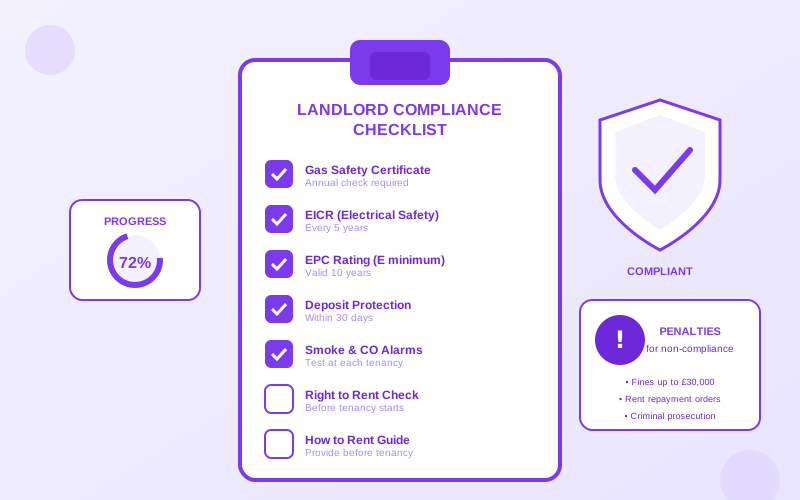
Before you can serve a valid Section 21 notice, you must have complied with several legal requirements. If any of these are missing, your notice will be invalid and the court will not grant possession.
Mandatory Compliance Checklist
| Requirement | Details | Consequence if Missing |
|---|---|---|
| Deposit Protection | Protected in approved scheme within 30 days | Section 21 invalid |
| Prescribed Information | Given to tenant within 30 days of deposit | Section 21 invalid |
| Gas Safety Certificate | Valid CP12 provided before tenancy started | Section 21 invalid |
| EPC | Valid EPC (rated E or above) provided | Section 21 invalid |
| How to Rent Guide | Current version given to tenant | Section 21 invalid |
| EICR | Satisfactory EICR report provided | Section 21 invalid |
Section 21 Restrictions
You cannot serve a Section 21 notice if:
- The tenancy is less than 4 months old
- Within 6 months of the local authority serving an improvement notice
- You've charged an unlawful fee (Tenant Fees Act breach)
- The tenant made a legitimate complaint about conditions and you're retaliating
- You're not registered with a landlord licensing scheme (if required)
Take action now
Problem → solution
Need to act on this now?
- Notice, possession, and court flow in one place
- Step-by-step process from notice to filing
- Court-ready bundle outputs
Serving the Section 21 Notice
Once you've confirmed all pre-requisites are met, you can serve the Section 21 notice usingForm 6A—the prescribed notice form.
Form 6A Requirements
The Section 21 notice must:
- Use the current Form 6A (version dated October 2015 or later)
- Give at least 2 months' notice
- Not expire before the end of the fixed term (if applicable)
- Specify the correct date the tenant must leave by
- Be served on all tenants named on the tenancy agreement
Methods of Service
You can serve the notice by:
- Hand delivery: Give it directly to the tenant (keep a witness)
- First class post: Allow 2 extra days for deemed delivery
- Recorded delivery: Provides proof of delivery
- Email: Only if the tenancy agreement allows for electronic service
- Leaving at property: Through letterbox or attached to door
Proof of Service
Always keep evidence of service. Take photos, get a witness statement, or use recorded delivery. If the tenant disputes receiving the notice, you'll need to prove it was served correctly.
After the Notice Expires
Once the 2-month notice period has passed, the tenant should vacate the property. However, many tenants do not leave voluntarily. You then have two options:
Option 1: Wait for Voluntary Departure
Some tenants leave once they understand the notice is valid. You can:
- Send a polite reminder letter
- Offer to help with moving costs
- Agree a slightly later move-out date
Option 2: Apply to Court
If the tenant refuses to leave, you must apply to court for a possession order. You cannot:
- Change the locks while the tenant is out
- Remove the tenant's belongings
- Harass or intimidate the tenant
- Cut off utilities
These actions constitute illegal eviction—a criminal offence.
The Court Process
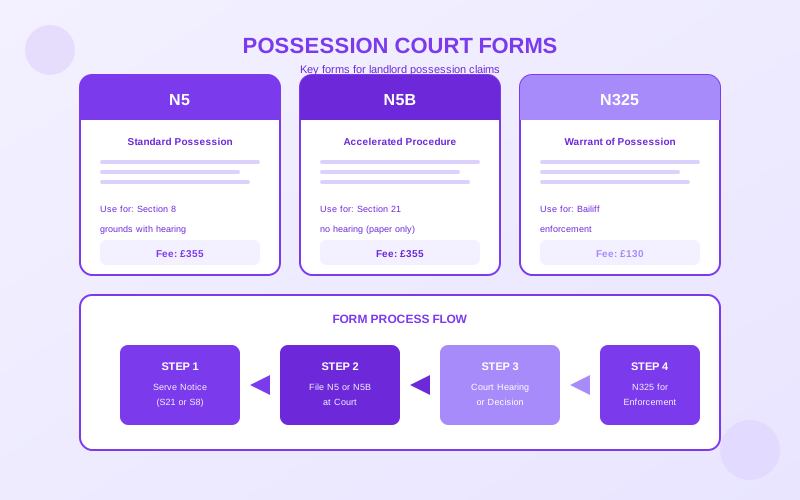
For Section 21 claims, you typically use the Accelerated Possession Procedure—a paper-based process without a hearing (in most cases).
Accelerated Possession Procedure
| Step | Action | Timeframe |
|---|---|---|
| 1 | Complete Form N5B and gather documents | 1-2 days |
| 2 | Submit to court with fee (£355) | 1 day |
| 3 | Court sends papers to tenant | 1-2 weeks |
| 4 | Tenant has 14 days to respond | 14 days |
| 5 | Judge reviews on paper | 2-6 weeks |
| 6 | Possession order issued | Usually 14 days to leave |
Documents Required
- Completed Form N5B
- Copy of the tenancy agreement
- Copy of the Section 21 notice (Form 6A)
- Proof of service
- Gas safety certificate
- EPC
- Deposit protection certificate
- Prescribed information
- How to Rent confirmation
Obtaining Possession
If the court grants a possession order, the tenant typically has 14 days to leave. If they still don't vacate:
Bailiff Enforcement
- Apply for a warrant of possession (Form N325 - £130 fee)
- The court schedules a bailiff appointment (usually 4-6 weeks)
- Bailiffs attend and remove the tenant if necessary
- You regain possession of your property
Get all court forms and step-by-step guidance with our Complete Eviction Pack →
Complete Timeline
Here's a realistic timeline for the entire Section 21 process:
| Stage | Duration | Running Total |
|---|---|---|
| Notice period | 2 months | 2 months |
| Court application processing | 6-8 weeks | 3.5-4 months |
| Possession order compliance | 14 days | 4-4.5 months |
| Bailiff warrant (if needed) | 4-6 weeks | 5-6 months |
| Total (if tenant resists) | - | 5-6 months |
Section 21 Process FAQ
How long is a Section 21 notice valid?
A Section 21 notice is valid for 10 months from the date it's served (for periodic tenancies) or 10 months from the end of the fixed term. You must start court proceedings within this window, or the notice expires.
Can I serve Section 21 during a fixed term?
Yes, but the notice cannot expire before the fixed term ends unless there's a break clause. You can serve it early, but the earliest possession date must align with the fixed term end.
What if the tenant has children or is vulnerable?
The Section 21 process is the same regardless of the tenant's circumstances. However, the court or bailiffs may delay enforcement in certain cases, and the local authority has duties to help homeless households. This doesn't affect your right to possession.
Can I claim rent arrears through Section 21?
No. Section 21 only provides possession—it doesn't award money. To recover rent arrears, you need to make a separate money claim. You can do this alongside or after the possession process.
What happens after Section 21 is abolished?
From 1 May 2026, you'll need to use Section 8 with one of the statutory grounds for possession. The government is introducing new and amended grounds (e.g., landlord selling, landlord moving in) but all require proving the ground applies.
Don't Wait—Section 21 Ends Soon
With Section 21 ending on 1 May 2026, landlords who may need to regain possession should serve their notices now. Our document generator creates court-ready Section 21 notices in minutes.
Generate Section 21 Notice Now →
Have a landlord question?
Ask Heaven is our free AI assistant that can help with eviction advice, tenancy questions, and more.