
Rated4.8/5 | 3008 reviews
Section 8 Eviction Process Explained (England, 2026)
Complete post-May guide to Section 8/Form 3A eviction in England. Learn the current possession grounds, notice periods, court forms, and evidence steps.
Use this guide when
You need a practical landlord answer, not just a definition
Use this page when you need to understand section 8 eviction in landlord terms, check the evidence or compliance points that matter, and decide whether the next step is a guide, free tool, notice pack, court pack, tenancy agreement, rent increase pack, or money claim route.
Your tenant owes rent and you need to know whether a Section 8 notice guide notice is the right move. This guide explains how it works, what can trip you up, and what to do next.
Need to act on an England possession ground now?
For post-1 May 2026 England cases, Section 21 has gone and the live route is the Form 3A possession notice. Choose the product that matches how far the case has gone.
- Eviction Notice Generator for the Form 3A notice, service instructions, validity checklist, compliance declaration, and arrears statement before you serve anything.
- Complete Eviction Pack if you want the notice, N5, N119, evidence checklist, witness material, and possession file working together from the start.
- Section 8 guide if you want the rule overview first.
- Ground-specific guides: Ground 1 occupation, Ground 1A sale, Ground 2 mortgagee sale, Ground 7A serious ASB, Ground 8 arrears, Ground 10 arrears, Ground 11 late rent, Ground 12 breach, Ground 13 property deterioration, Ground 14 ASB, Ground 15 furniture, and Ground 17 false statement.
Post-Section 21 World
From 1 May 2026, Section 8/Form 3A is the primary eviction route for England landlords. The current England eviction rules 2025 introduced new and amended grounds, making Section 8 more flexible—but you'll still need to prove your ground applies. Understanding Section 8 is now essential.
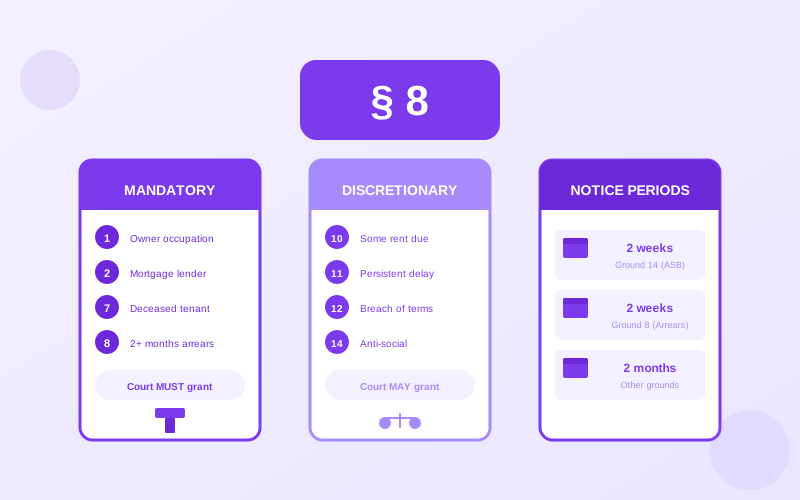
What Is Section 8?
Section 8 of the Housing Act 1988 provides the legal framework for landlords to seek possession of a property by proving one or more statutory grounds. These grounds are divided into two categories:
Unpaid rent
Tenant still owes money? Prepare the claim file
If the arrears keep growing, turn the problem into a clearer debt record and claim narrative before the evidence gets harder to untangle.
- Set out what is owed clearly before the numbers get harder to untangle.
- Build the claim in plain English.
- Get the court paperwork ready for the next step.

- Mandatory grounds: If proven, the court must grant possession
- Discretionary grounds: Even if proven, the court may grant possession (considering reasonableness)
Key Features of Section 8
- Grounds required: You must specify and prove at least one ground
- Variable notice periods: Immediate to 4 months depending on the current Form 3A ground
- step-by-step UK eviction process usually required: Unlike accelerated Section 21 procedure
- Can claim rent arrears: Unlike Section 21, you can claim money owed
- Can be served anytime: During fixed term or periodic tenancy
Mandatory Grounds (1-8)
If you prove a mandatory ground, the court must grant a possession order. There is no discretion—the judge cannot refuse or delay based on the tenant's circumstances.
| Ground | Description | Notice Period |
|---|---|---|
| Ground 1 | Landlord or qualifying family occupation after the tenancy has run long enough | 4 months |
| Ground 2 | Mortgage lender requires possession to sell | 4 months |
| Ground 3 | Out-of-season holiday let | 2 weeks |
| Ground 4 | Student let by educational institution | 2 weeks |
| Ground 5 | Property required for minister of religion | 2 months |
| Ground 6 | Landlord intends to demolish or substantially reconstruct | 4 months |
| Ground 7 | Tenant has died and tenancy passed to successor | 2 months |
| Ground 8 | Serious rent arrears (3 months, or 13 weeks if paid weekly or fortnightly, at notice AND hearing) | 4 weeks |
Ground 8: The Most Powerful Ground
Ground 8 is the most commonly used mandatory ground. If the tenant owes at least 3 months' rent, or 13 weeks' rent if paid weekly or fortnightly, when you serve the notice AND at the court hearing, possession is mandatory. However, if they pay down below the Ground 8 threshold at any point, you lose the mandatory element.Read our detailed Ground 8 guide ?
Discretionary Grounds (9-17)
With discretionary grounds, even if proven, the court must also consider whether it's reasonable to grant possession. The judge weighs factors like:
- The tenant's circumstances (health, children, vulnerability)
- The severity of the breach
- Whether the breach is ongoing or resolved
- The landlord's need for possession
| Ground | Description | Notice Period |
|---|---|---|
| Ground 9 | Suitable alternative accommodation available | 2 months |
| Ground 10 | Some rent arrears (any amount at notice and hearing) | 4 weeks |
| Ground 11 | Persistent delay in paying rent | 4 weeks |
| Ground 12 | Breach of tenancy terms (other than rent) | 2 weeks |
| Ground 13 | Property condition deteriorated due to tenant's neglect | 2 weeks |
| Ground 14 | Antisocial behaviour or criminal activity | Immediate |
| Ground 14A | Domestic violence (partner has left) | 2 weeks |
| Ground 15 | Furniture condition deteriorated due to tenant's neglect | 2 weeks |
| Ground 16 | Employee tenant no longer employed | 2 months |
| Ground 17 | Tenant gave false information to obtain tenancy | 2 weeks |
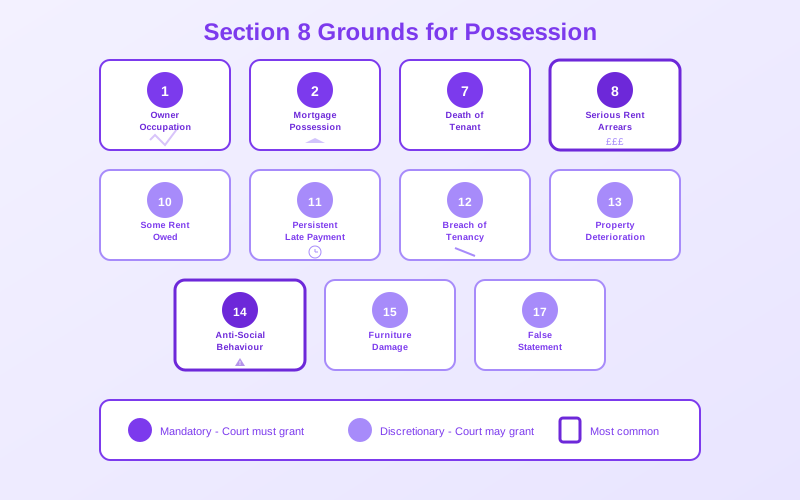
Notice Periods
Section 8 notice periods vary by ground:
- Immediate: Ground 14 (antisocial behaviour) - can apply to court same day
- Immediate: Grounds 7A and 14 where immediate application is allowed
- 2 weeks: Grounds such as 4, 7B, 12, 13, 14A, 14ZA, 15, and 17
- 4 weeks: Grounds 8, 10, 11, 5E, 5F, 5G, and 18
- 2 months: Grounds such as 5, 5A, 5B, 5C, 5H, 7, and 9
- 4 months: Grounds such as 1, 1A, 2, 2ZA-2ZD, 4A, 6, and 6B
If you're using multiple grounds with different notice periods, you must wait for the longest period before applying to court.
Serving the Section 8 Notice
The Section 8 notice must be served using the current Form 3A prescribed notice.
Notice Requirements
- Use the correct Form 3 (current version)
- Specify which grounds you're relying on
- Provide particulars (details supporting each ground)
- State the earliest date court proceedings can begin
- Serve on all tenants
Particulars of the Grounds
Unlike Section 21, you must explain why each ground applies. For example:
- Ground 8: "The tenant owes £3,450 in rent, representing 3 months and 2 weeks of arrears as at [date]"
- Ground 12: "The tenant has breached clause 4.2 of the tenancy agreement by keeping a dog without permission"
- Ground 14: "On [dates], the tenant engaged in antisocial behaviour including [specific incidents with dates and details]"
Be Specific
Vague particulars can invalidate your notice. Include dates, amounts, specific incidents, and reference the relevant tenancy clauses. The more detail, the stronger your case.
The Court Process
Unlike Section 21's accelerated procedure, Section 8 claims typically require a court hearing.
Step-by-Step Process
| Step | Action | Timeframe |
|---|---|---|
| 1 | Complete Form N5 and N119 for the standard possession claim | 1-2 days |
| 2 | Submit to county court with fee (£355) | 1 day |
| 3 | Court schedules hearing and notifies tenant | 4-8 weeks |
| 4 | Attend possession hearing | 15-30 mins |
| 5 | Judge makes decision | Same day |
| 6 | Possession order (if granted) - usually 14-28 days | 2-4 weeks |
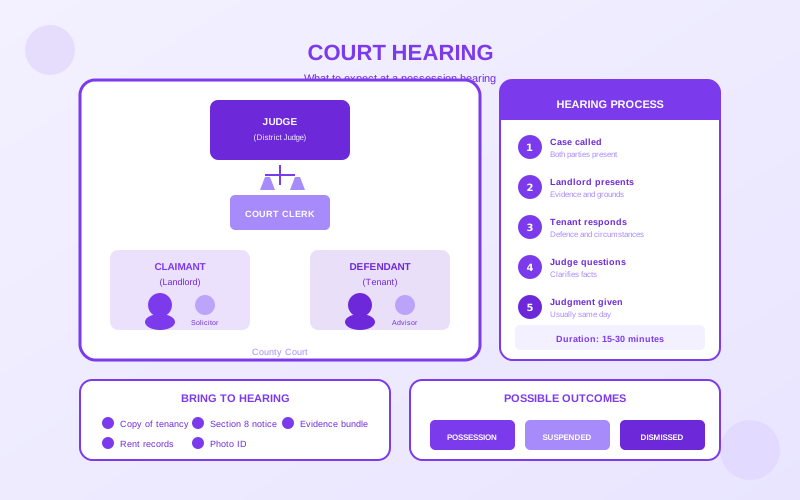
At the Hearing
You'll need to:
- Prove the ground applies (bring evidence: rent statements, photos, witness statements)
- Show the notice was valid and properly served
- Answer the judge's questions about the case
- For discretionary grounds: Explain why possession is reasonable
Get all court forms, witness statement templates, and hearing guidance ?
Section 8 vs Section 21 After the Ban
For new England cases after 1 May 2026, this is not a live choice. Section 21 is abolished for new notices and landlords use Form 3A with the correct possession ground. The comparison below is useful only for understanding legacy cases and why the current process is different:
| Use Form 3A / Section 8 Now When... | Section 21 Was Previously Used When... |
|---|---|
| Tenant owes 3 months' rent, or 13 weeks if paid weekly or fortnightly (Ground 8) | No specific grounds but want tenant out |
| Serious antisocial behaviour (immediate action) | Compliance issues might invalidate Section 8 |
| You want to claim rent arrears at same time | You want the simpler accelerated procedure |
| Tenancy is in fixed term with no break clause | You want more certainty (if valid) |
| After 1 May 2026 for new England cases | Only legacy notices served before the deadline |
Read our detailed Section 21 vs Section 8 comparison ?
Section 8 FAQ
How long is a Section 8 notice valid?
A Section 8 notice is valid for 12 months from the date specified as the earliest date for court proceedings. You must issue court proceedings within this period.
Can I use multiple grounds?
Yes, and it's often advisable. For rent arrears, landlords typically use Ground 8 (mandatory) AND Grounds 10 and 11 (discretionary) as backup. If the tenant pays down below the Ground 8 threshold, you still have the discretionary grounds.
What if the tenant pays off arrears before the hearing?
For Ground 8, the tenant must owe at least 3 months' rent, or 13 weeks' rent if paid weekly or fortnightly, at both the notice date AND the hearing date. If they pay down below the Ground 8 threshold, you lose Ground 8 (but can still pursue Ground 10/11). Some tenants strategically pay just enough to defeat Ground 8.
Do I need a solicitor for a Section 8 hearing?
No, many landlords represent themselves. However, for complex cases (disputed facts, vulnerable tenants, counterclaims), legal representation can help. Our Complete Eviction Pack includes guidance for self-representation.
Can the tenant defend a Section 8 claim?
Yes. Common defences include: disputing the arrears amount, claiming repairs were needed (set-off), arguing the notice was invalid, or (for discretionary grounds) arguing possession isn't reasonable due to their circumstances.
Create Your Section 8 Notice
Create a Section 8 notice with the right particulars for each ground. Includes guidance on evidence gathering and the court process.
Create Section 8 Notice ?Prefer us to prepare it with you?
Free consultation before any assisted eviction preparation is agreed
We discuss the facts first. If we can help, we confirm the scope and send a secure Stripe payment link afterwards.
Unsure about grounds or dates?
Landlord Section 8 notice assistance
Free consultation · £149.00 only if we confirm we can help
Before you serve, we help organise your Form 3A, tenant details, notice timing, service plan and evidence prompts around the facts you approve.
Book free consultation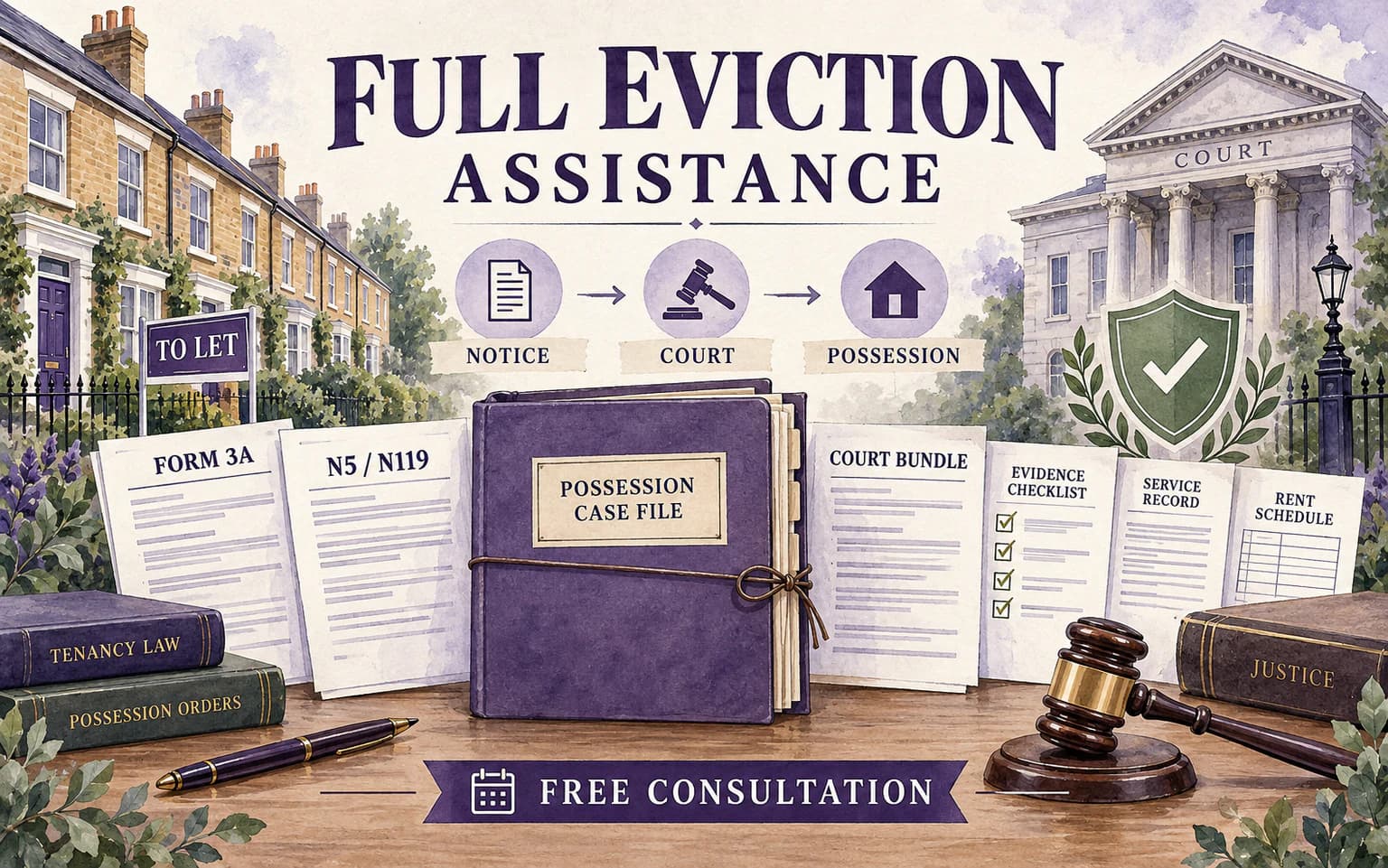
Want the full case, including court forms?
Landlord eviction assistance service
Free consultation · £399.00 only if we confirm we can help
Our £399 full-case service can cover your Section 8 notice, service record, N5, N119 particulars of claim and supporting bundle. If you have already served notice, we focus on the court-stage pack.
Book free consultationWhat to do next
Core eviction guides landlords usually need next
These are the core possession guides landlords usually need after notice or arrears problems start.
FAQs for landlords

Have a landlord question?
Ask Heaven is our free AI assistant that can help with eviction advice, tenancy questions, and more.