
Rated4.8/5 | 3008 reviews
Standard Possession Procedure England - When You Need It (2026 Guide)
The standard possession procedure is required for Section 8 evictions and when claiming rent arrears. Learn the full court process, hearing preparation, and...
Use this guide when
You need a practical landlord answer, not just a definition
Use this page when you need to understand standard possession procedure in landlord terms, check the evidence or compliance points that matter, and decide whether the next step is a guide, free tool, notice pack, court pack, tenancy agreement, rent increase pack, or money claim route.
Your tenant owes rent and you need to know whether a Section 8 notice guide notice is the right move. This guide explains how it works, what can trip you up, and what to do next.
Post-2026 Essential
After 1 May 2026, when Section 21 is abolished for new notices, most new England possession claims will use the standard possession procedure. Section 8 grounds usually require a hearing, so mastering this process is essential for every landlord.
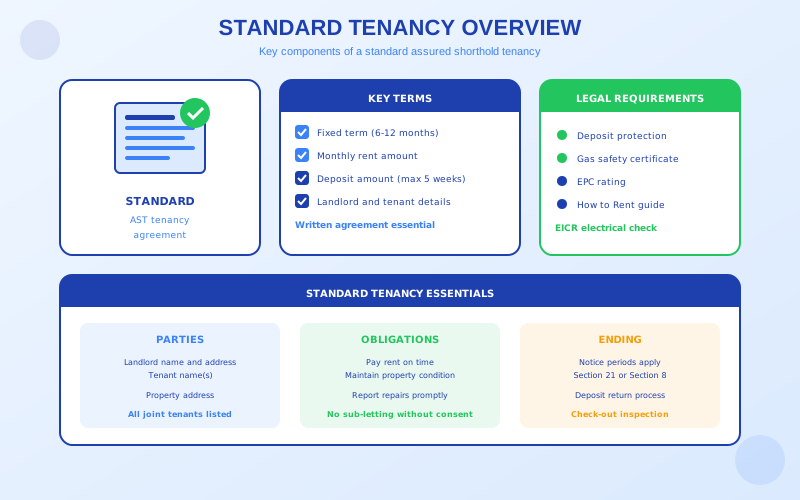
What Is Standard Possession?
Standard possession is a court procedure under Part 55 of the Civil Procedure Rules where a district judge hears your claim for possession at a scheduled hearing. Both the landlord and tenant receive notice of the hearing date and can attend to argue their case.
Unpaid rent
Tenant still owes money? Prepare the claim file
If the arrears keep growing, turn the problem into a clearer debt record and claim narrative before the evidence gets harder to untangle.
- Set out what is owed clearly before the numbers get harder to untangle.
- Build the claim in plain English.
- Get the court paperwork ready for the next step.

The key features of standard possession are:
- step-by-step UK eviction process: A judge hears both sides before making a decision
- Evidence required: You must prove your grounds for possession
- Money claims allowed: You can claim rent arrears in the same proceedings
- Works with current Form 3A claims: Required for Section 8 and legacy Section 21 cases where standard procedure is used
- Judge's discretion: For discretionary grounds, the judge decides if possession is reasonable
This procedure gives both parties the opportunity to present evidence, call witnesses if needed, and respond to the other side's arguments. It's more thorough than accelerated possession but takes longer.
When Is Standard Possession Required?
You must use standard possession in these situations:
1. Section 8 Evictions
All Section 8 claims require a hearing. The judge must assess whether your grounds are proven and, for discretionary grounds, whether it's reasonable to grant possession. There is no paper-based route for Section 8.
2. Claiming Rent Arrears
If you want to recover evict tenant not paying rent guide as part of your eviction proceedings, you must use standard possession. The accelerated procedure is possession-only—no money claims allowed.
3. Complex Cases
When there are disputes about the tenancy, the validity of notices, or other contested issues, a hearing allows you to present evidence and argue your case.
4. When Accelerated Isn't Available
If you are dealing with a legacy Section 21 case that does not meet accelerated requirements, you may need standard procedure. For new England notices, start with the Form 3A / Section 8 route.
Optional for Section 21
This is now mainly a legacy point. New England notices after 1 May 2026 do not start with Section 21. If you want to claim possession and arrears together, prepare the current Form 3A / N5 / N119 file.
Forms and Documents
To issue a standard possession claim, you need:
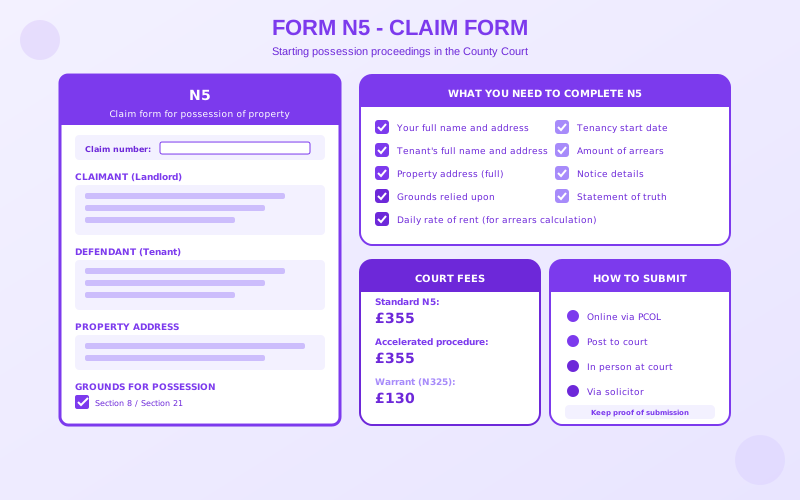
Form N5 - Claim for Possession
The standard claim form for possession of property. It includes sections for:
- Claimant (landlord) and defendant (tenant) details
- Property address and description
- Type of tenancy and when it started
- Details of any notice served (usually the current Form 3A / Section 8 notice for new England cases)
- Grounds for possession (if using Section 8)
- Particulars of claim (why you want possession)
- money claim for unpaid rent if applicable (rent arrears amount)
Form N119 - Particulars of Claim
For possession claims, you typically complete Form N119 which provides detailed grounds. This form specifically covers:
- The type of tenancy (AST, assured, etc.)
- Notice details (which notice, when served, expiry date)
- Rent arrears calculations if claiming money
- Statement of the grounds relied upon
Supporting Documents
- Tenancy agreement: Copy of the full agreement
- Form 3A / Section 8 notice: The notice you served
- Proof of service: How and when the notice was delivered
- Rent schedule: Showing arrears if claiming money
- Evidence of grounds: Depending on which grounds you're using
Issuing Your Claim
Follow these steps to issue your standard possession claim:
Step 1: Complete the Forms
Fill in Form N5 and N119 accurately. Any errors can delay your case or result in the claim being struck out. Double-check all dates, amounts, and addresses.
Step 2: Prepare Copies
Make enough copies for the court, each tenant named on the claim, and yourself. Typically:
- 1 copy for the court
- 1 copy for each defendant (tenant)
- 1 copy for your records
Step 3: Submit to the Correct Court
File your claim at the county court that covers the property location. You can submit:
- Online: Through Possession Claims Online (PCOL) at gov.uk
- By post: Send to the county court with fee payment
- In person: Deliver to the court counter (check opening hours)
Step 4: Pay the Court Fee
The fee for a standard possession claim is £365. If you're also claiming rent arrears, additional fees may apply based on the amount claimed.
Step 5: Court Issues and Serves
The court will issue the claim (stamp it with a case number) and serve it on the tenant(s). They will set a hearing date, typically 4-8 weeks after issue, and notify all parties.
The Court Hearing
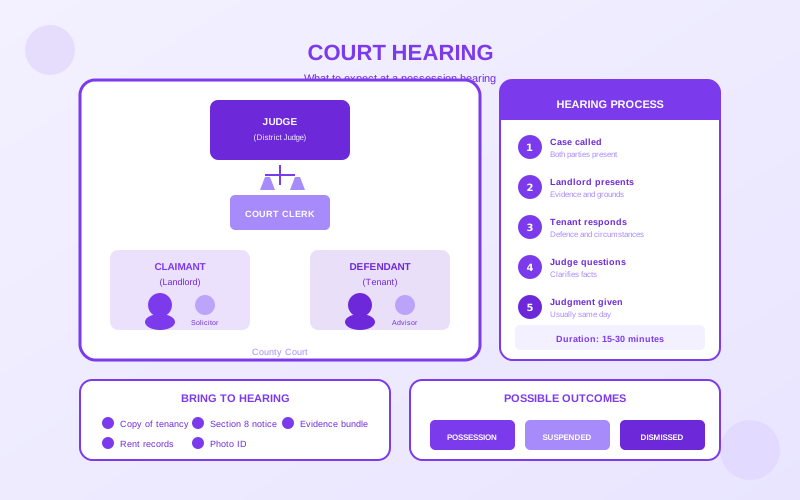
The hearing is your opportunity to present your case. Here's what to expect:
Arrival and Waiting
Arrive at least 30 minutes early. Check the court board for your case and courtroom number. The hearing may be listed as a "housing list" with multiple cases heard one after another.
Before the Judge
When called, enter the courtroom. The judge (usually a district judge) will be at the front. You can represent yourself or have a solicitor/barrister appear for you. Stand when speaking to the judge.
Presenting Your Case
The judge will ask you to explain your claim. Be prepared to:
- Confirm the tenancy details and rent amount
- Explain which notice you served and when
- State which grounds you're relying on
- Provide current arrears figures if claiming money
- Present any additional evidence supporting your grounds
Tenant's Response
The tenant can respond to your claims. They might dispute the arrears, argue the notice was invalid, or explain circumstances (illness, benefits issues, etc.). For discretionary grounds, they may argue it's not reasonable to grant possession.
Judge's Decision
After hearing both sides, the judge makes a decision. For mandatory grounds such as Ground 8, the judge must grant possession if the post-May 2026 arrears threshold is met at the notice date and hearing. For discretionary grounds, the judge decides what's reasonable.
Preparing Your Evidence
Strong evidence is crucial for a successful outcome. Bring:
Essential Documents
- Original tenancy agreement: Signed copy if possible
- Your notice: Section 8 or 21 with proof of service
- Rent schedule: Dated ledger showing all rent due and payments
- Bank statements: Showing rent payments (or lack thereof)
- Correspondence: Letters, emails, or texts about arrears or issues
Ground-Specific Evidence
Depending on your grounds, you may need additional evidence:
- Ground 8: Up-to-date arrears calculation showing 3 months' rent owed, or 13 weeks' rent if paid weekly or fortnightly
- Ground 14: Incident reports, neighbour statements, police reports
- Ground 12: Evidence of specific tenancy breaches
- Ground 1: Proof you previously lived there and need to return
Witness Statements
If you have witnesses (neighbours, managing agents), prepare signed witness statements. The court may allow witnesses to give oral evidence, but written statements are usually sufficient.
Top Tip
Organize your documents in a bundle with numbered pages and an index. This makes it easy to reference specific documents during the hearing and demonstrates professionalism to the judge.
Possible Outcomes
The judge may make one of several orders:
Outright Possession Order
The tenant must leave by a specified date (usually 14 days, or 28 days if exceptional hardship). If they don't leave, you can apply for a bailiff warrant.
Suspended Possession Order
Common for rent arrears cases. The possession order is suspended as long as the tenant pays current rent plus an agreed amount toward arrears (e.g., £50/month). If they default, the suspension lifts and you can request a warrant.
Money Judgment
If you claimed rent arrears, the judge may order the tenant to pay the amount owed. This creates a County Court Judgment (CCJ) that you can enforce if they don't pay.
Adjournment
The judge may adjourn (postpone) the case if more information is needed or to give the tenant time to obtain legal advice. Adjournments are frustrating but sometimes unavoidable.
Claim Dismissed
If the judge finds your notice was invalid, grounds aren't proven, or (for discretionary grounds) it's not reasonable to order possession, your claim may be dismissed. You may be able to start again with a new notice.
After the Possession Order
Once you have a possession order:
If the Tenant Leaves
Ideal outcome. Change the locks once the property is vacant. Take inventory, deal with any belongings left behind according to the Torts (Interference with Goods) Act 1977.
If the Tenant Doesn't Leave
Apply for a warrant for possession using Form N325. The county court bailiff will schedule an eviction date. This typically takes 4-8 weeks. You can also use High Court enforcement (Form N293A) which is often faster.
For more on the bailiff process, see our Bailiff Eviction Day guide.
Timelines and Costs
Standard possession takes longer than accelerated. Here are realistic timeframes:
| Stage | Section 8 | Section 21 |
|---|---|---|
| Notice period | Immediate - 4 months* | 2 months |
| Court processing | 2-4 weeks | 2-4 weeks |
| Wait for hearing | 4-8 weeks | 4-8 weeks |
| Possession order compliance | 14-28 days | 14-28 days |
| Bailiff (if needed) | 4-8 weeks | 4-8 weeks |
| Total (typical) | 4-6 months | 5-7 months |
*Section 8/Form 3A notice periods vary by ground. Ground 8 rent arrears requires 4 weeks; Ground 1 landlord/family occupation usually requires 4 months.
Costs
- Court fee: £365 for possession claim
- Money claim fee: Additional fee based on amount (e.g., £115 for claims up to £5,000)
- Bailiff warrant: £130
- High Court transfer: £71 (if using HCEO instead of county court bailiff)
- Solicitor (optional): £800-2,500+ depending on complexity
Standard Possession FAQ
Can I represent myself at the hearing?
Yes. Many landlords represent themselves (known as being a "litigant in person"). The judge will make allowances for non-lawyers. However, for complex cases or high-value claims, consider instructing a solicitor.
What if the tenant doesn't attend the hearing?
The hearing proceeds in their absence. You'll still need to prove your case, but without opposition, possession is usually granted. The judge may require proof the tenant was properly served with the claim.
Can I get costs awarded against the tenant?
Yes, but recovery is often difficult. The court can order the tenant to pay your court fees and, if you had legal representation, some legal costs. However, if the tenant has no money, the judgment may be unenforceable.
What if I can't attend the hearing date?
Contact the court as early as possible to request an adjournment. You'll need a good reason (illness, unavoidable work commitment, etc.). Alternatively, you can appoint someone to attend on your behalf with a signed authority letter.
Can I appeal if possession is refused?
Yes, you can apply for permission to appeal to a circuit judge. You must apply within 21 days of the decision. Appeals are only granted if the judge made an error of law or the decision was plainly wrong.
Is video/remote hearing available?
Some courts offer video hearings (Cloud Video Platform). Check with the court when you receive your hearing notice. Remote hearings became more common after 2020 and many courts still offer them.
Prepare for Your Possession Hearing
The Complete Eviction Pack includes the notice route, Form N5 guidance, a rent arrears schedule template, and a hearing preparation checklist. Be fully prepared when you face the judge.
Get Complete Eviction Pack ?Prefer us to prepare it with you?
Free consultation before any assisted eviction preparation is agreed
We discuss the facts first. If we can help, we confirm the scope and send a secure Stripe payment link afterwards.
Unsure about grounds or dates?
Landlord Section 8 notice assistance
Free consultation · £149.00 only if we confirm we can help
Before you serve, we help organise your Form 3A, tenant details, notice timing, service plan and evidence prompts around the facts you approve.
Book free consultation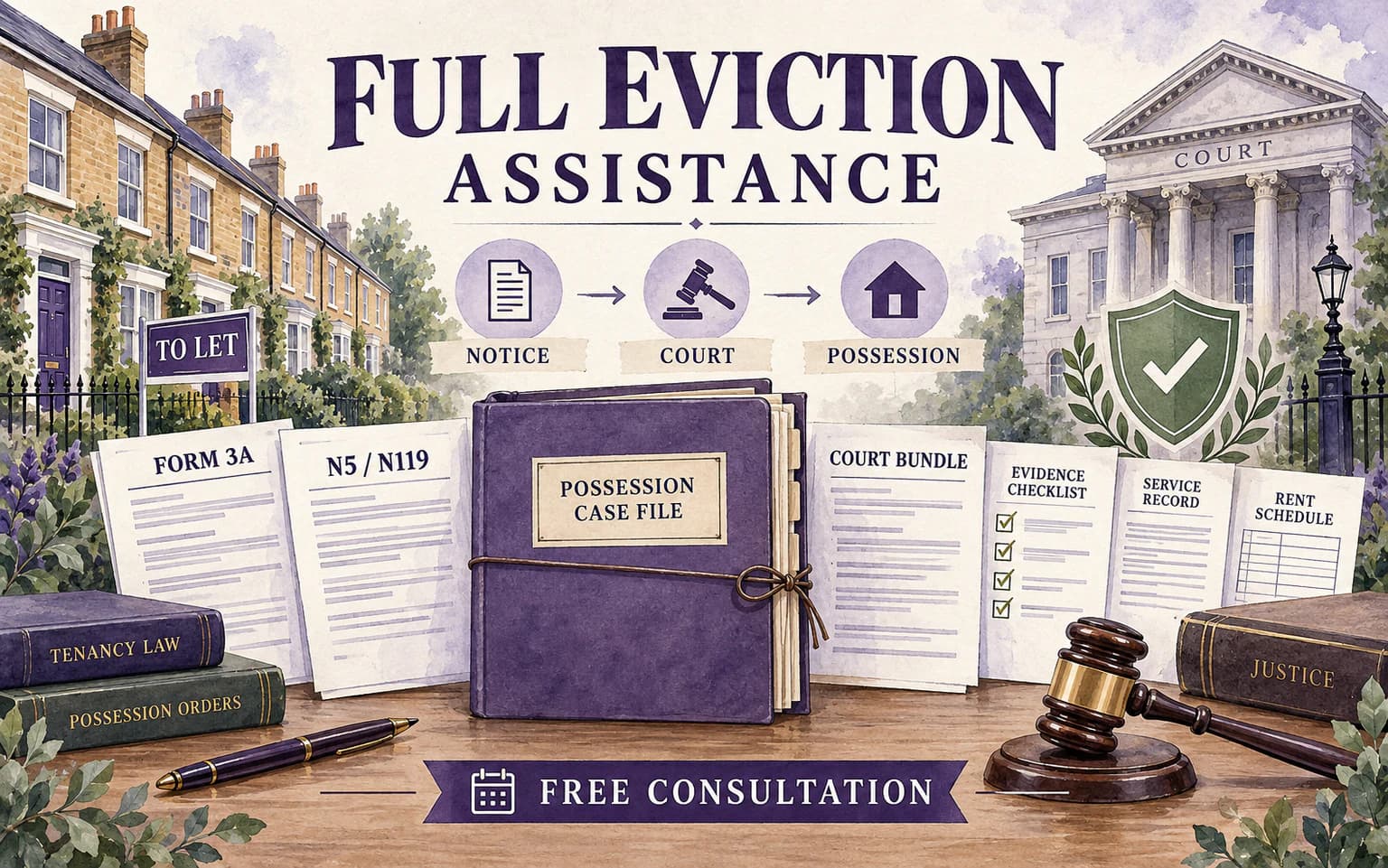
Want the full case, including court forms?
Landlord eviction assistance service
Free consultation · £399.00 only if we confirm we can help
Our £399 full-case service can cover your Section 8 notice, service record, N5, N119 particulars of claim and supporting bundle. If you have already served notice, we focus on the court-stage pack.
Book free consultationWhat to do next
Core eviction guides landlords usually need next
These are the core possession guides landlords usually need after notice or arrears problems start.
FAQs for landlords

Have a landlord question?
Ask Heaven is our free AI assistant that can help with eviction advice, tenancy questions, and more.