
Rated4.8/5 | 3008 reviews
Section 8 Ground 17 Explained: False Statement by Tenant (England)
Ground 17 allows eviction when a tenant obtained the tenancy through false statements. Learn what qualifies, how to prove fraud, and the court process.
Assisted prep
Need help preparing your Section 8 notice?
Start with a free consultation. If suitable, we can help prepare the Form 3A notice, service record and supporting evidence before you serve it.
Book free consultationUse this guide when
You need a practical landlord answer, not just a definition
Use this page when you need to understand section 8 ground 17 false statement in landlord terms, check the evidence or compliance points that matter, and decide whether the next step is a guide, free tool, notice pack, court pack, tenancy agreement, rent increase pack, or money claim route.
Your tenant is breaching the tenancy and you need to know whether Section 8 notice guide is the right route. This guide explains how it works, what evidence matters, and what to do next.
What landlords should do next
If you are under pressure, decide the route early. In England after 1 May 2026, Section 21 is no longer the live route for new cases. If this ground fits, the next step is using the current Form 3A process with the right evidence and timing.
Need to act on an England possession ground now?
For post-1 May 2026 England cases, Section 21 has gone and the live route is the Form 3A possession notice. Choose the product that matches how far the case has gone.
- Eviction Notice Generator for the Form 3A notice, service instructions, validity checklist, compliance declaration, and arrears statement before you serve anything.
- Complete Eviction Pack if you want the notice, N5, N119, evidence checklist, witness material, and possession file working together from the start.
- Section 8 guide if you want the rule overview first.
- Ground-specific guides: Ground 1 occupation, Ground 1A sale, Ground 2 mortgagee sale, Ground 7A serious ASB, Ground 8 arrears, Ground 10 arrears, Ground 11 late rent, Ground 12 breach, Ground 13 property deterioration, Ground 14 ASB, Ground 15 furniture, and Ground 17 false statement.
Key Requirements
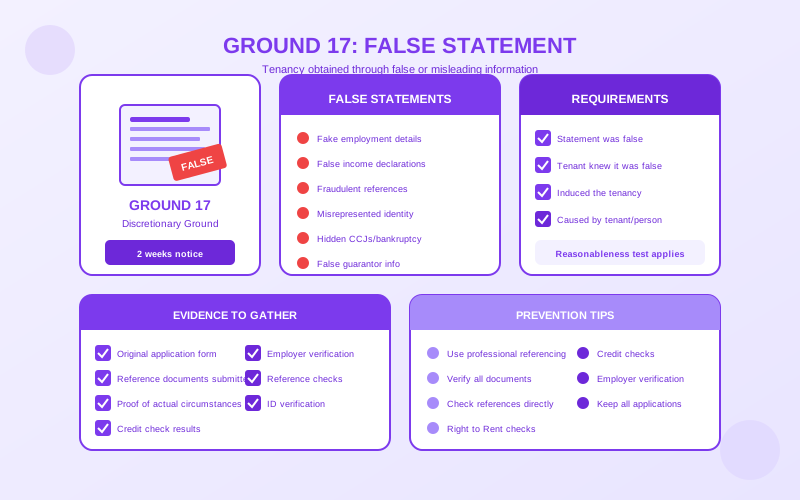
Ground 17 requires two elements: (1) the tenant made a false statement, and (2) that false statement induced you to grant the tenancy. You must show you wouldn't have let to them if you'd known the truth.
What Is Ground 17?
Ground 17 is set out in Schedule 2, Part II of the Housing Act 1988. The full wording states:
Next step for landlords
Problem clear? Create the right notice before you serve
If the issue now points toward possession, move from guidance into a notice route that keeps grounds, dates, service, and evidence together.
- Choose the right route before you serve anything.
- Answer plain-English questions. We handle the legal logic.
- Preview the paperwork before you pay.

"The tenant is the person, or one of the persons, to whom the tenancy was granted and the landlord was induced to grant the tenancy by a false statement made knowingly or recklessly by—
(a) the tenant, or
(b) a person acting at the tenant's instigation."
Key Elements
- False statement: A statement of fact that was untrue
- Knowingly or recklessly: Made deliberately or with disregard for truth
- By tenant or their agent: Either the tenant themselves or someone acting for them
- Induced: The statement caused you to grant the tenancy
Ground Details
- Type: Discretionary—reasonableness test applies
- Notice period: 2 weeks minimum
- Original tenant only: Applies to the person who made the false statement
Common Examples of False Statements
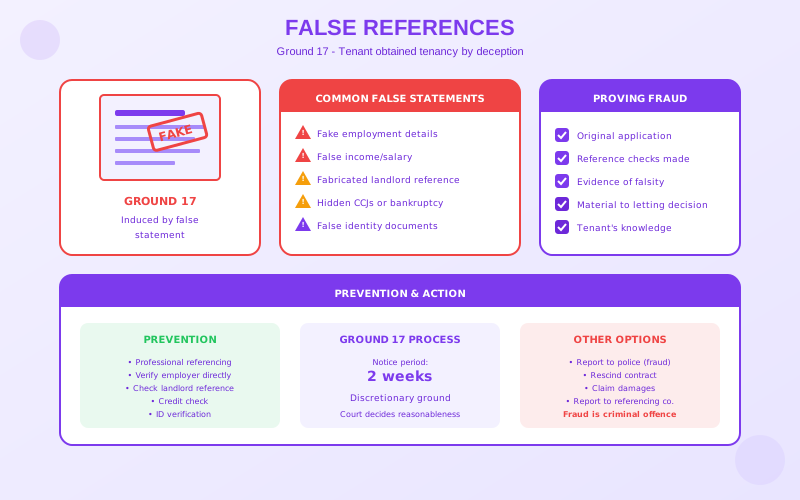
False statements that can support Ground 17 include:
Employment and Income
- Claiming to be employed when unemployed
- Falsifying income figures or payslips
- Inventing a job title or employer
- Hiding that income is from temporary or unreliable sources
References
- Providing fake landlord references
- Getting friends to pose as previous landlords
- Hiding previous evictions or possession orders
- Fabricating rental history
Personal Information
- Using false identity documents
- Hiding that other people will live in the property
- Misrepresenting family composition
- Failing to disclose pets when asked directly
Credit and History
- Hiding CCJs (County Court Judgments)
- Concealing previous bankruptcies
- Failing to disclose criminal convictions (if asked)
Proving a False Statement
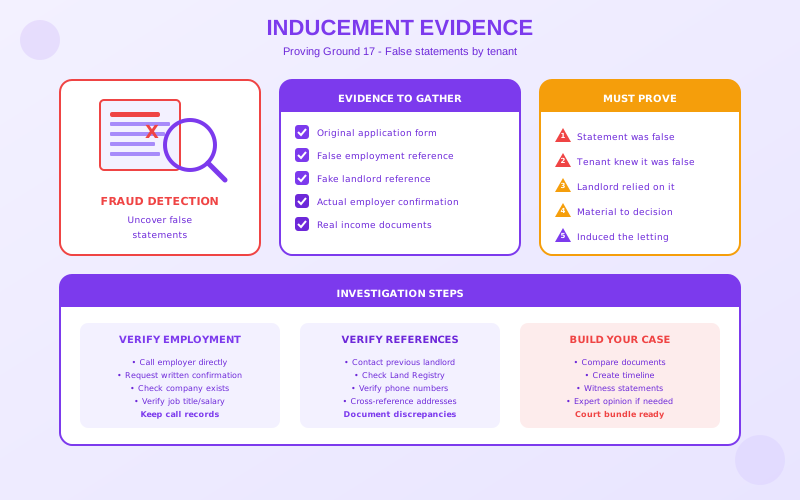
To succeed with Ground 17, you must prove:
1. A Statement Was Made
The false statement must be documented. This could be:
- Application form completed by the tenant
- Reference letters provided
- Emails or messages about their circumstances
- Verbal statements you can prove were made (ideally with a witness)
2. The Statement Was False
You need evidence that what they said wasn't true:
- Employment claims: Contact the employer; request HMRC records
- References: Trace the actual contact; check if property existed
- Identity: Credit checks; official records
- Income: Bank statements showing different amounts
3. It Was Made Knowingly or Recklessly
You must show the tenant either knew the statement was false or didn't care whether it was true or not. Innocent mistakes don't qualify. Evidence might include:
- The lie was too specific to be an error
- They had to know the truth (e.g., they know their own employment status)
- Documents were clearly forged
- Pattern of deception
Omissions vs Statements
Simply failing to volunteer information may not be enough—Ground 17 requires a positive false statement. However, if you asked a direct question (e.g., "Do you have any CCJs?") and they answered falsely, that qualifies.
The Inducement Requirement
This is often the most challenging element. You must prove that the false statement inducedyou to grant the tenancy. This means showing:
What You Would Have Done
- If you'd known the truth, you wouldn't have granted the tenancy
- The false statement was material to your decision
- You relied on the information when choosing to let to them
Evidence of Inducement
- Referencing criteria: Your standard criteria that the tenant would have failed
- Income requirements: If you require 3x rent income and they falsified income
- Other rejected applications: Other applicants you rejected for similar issues
- Agent procedures: If your agent has documented referencing standards
Example Scenario
A tenant claims to earn £45,000/year on their application. Your minimum requirement is income of 30x monthly rent. For rent of £1,500/month, minimum income is £45,000. You later discover they actually earn £25,000. The false statement induced you to grant the tenancy because without it, they wouldn't have met your criteria.
Court Process and Notice
Notice Requirements
Ground 17 requires a minimum of 2 weeks' notice on your Form 3A notice. The notice should:
- Specify Ground 17
- Describe the false statement(s)
- Explain how you discovered the statement was false
- State how it induced you to grant the tenancy
step-by-step UK eviction process
Ground 17 uses the standard possession procedure. At the hearing:
- You present evidence of the false statement
- You explain how it induced you to grant the tenancy
- The tenant can respond and dispute your claims
- The judge decides if the ground is proven AND if possession is reasonable
Reasonableness Factors
Even if you prove Ground 17, the court considers reasonableness. Factors include:
- Severity of the deception
- Whether the tenant has been a good tenant otherwise
- Current circumstances (would they now qualify?)
- Impact of eviction on vulnerable household members
- How long ago the false statement was made
Combining Grounds
Ground 17 often accompanies other grounds. If the tenant is also in rent arrears (Ground 8/10/11) or causing problems (Ground 14), include all applicable grounds. This strengthens your case if Ground 17 alone is considered insufficient.
Ground 17 FAQ
Can I use Ground 17 if my agent did the referencing?
Yes. The false statement induced the grant of tenancy, whether you or your agent relied on it. Your agent acts on your behalf, so a false statement that misled them also qualifies.
What if the tenant's friend gave a fake reference?
Ground 17 covers statements made by "a person acting at the tenant's instigation." If the tenant asked someone to pose as a previous landlord, that counts as the tenant's false statement.
What if I didn't formally ask for references?
Ground 17 applies to any false statement that induced the tenancy, not just formal application forms. However, it's harder to prove inducement if you didn't have documented criteria. Going forward, always use formal applications.
Is there a time limit for using Ground 17?
No statutory time limit, but courts may consider how long ago the false statement was made. If the tenant has been a good tenant for years, a judge might find eviction unreasonable. Act promptly when you discover fraud.
Can I recover damages for tenant fraud?
Separately from possession, you might have a civil claim for fraudulent misrepresentation. This could cover costs you incurred due to the fraud. However, this is a separate legal action and typically requires legal advice.
What if the tenant has now started paying rent properly?
Current good behaviour helps the tenant's case on reasonableness but doesn't erase the fraud. You can still pursue Ground 17, especially if the original deception was serious. The court weighs all factors.
Protect Your Property
Our eviction document packages include Section 8 notices for all grounds including Ground 17. We also offer tenant application templates to help prevent fraud in the first place.
Create my Section 8 noticeA clearer route from ground to possession
What to prepare for Section 8 Ground 17
Keep the reason for possession, the notice, proof of service and later court evidence consistent from the outset. Choose the route that matches what you need to do next.
Match the facts
Use the ground only where your evidence supports the reason you will give.
Prepare and serve
Check the notice details, timing and service record before you send anything.
Keep the file joined up
Store the notice, service proof and supporting documents for any court stage.
Choose your document route
Start at the stage your case is actually in

Stage 1: serve the Section 8 notice
£39.99Choose this route when your immediate job is preparing Form 3A and a clear service record before anything is sent to the tenant.
- Problem it solves
- It keeps the ground, tenant details, notice date and service evidence in one notice-stage file.
- Risk if this is not the right stage
- If the tenant stays, you will still need to prepare the court claim file at the next stage.
- Landlord outcome
- You have a structured notice and service route ready to review, approve and serve yourself.

Stage 2: build the full possession file
£69.99Choose this route when you want the Section 8 notice and the court-stage forms, evidence structure and hearing prompts planned together.
- Problem it solves
- It avoids building the notice file first and then trying to reconstruct the same facts for court later.
- Risk if this is not the right stage
- If you only need to serve notice now, this may be more preparation than your case needs today.
- Landlord outcome
- You can prepare one joined-up file for notice, N5, N119, evidence and the court stage.
Prefer us to prepare it with you?
Start with a free consultation before any paid work is agreed
Tell us what has happened and show us the documents you have. We confirm whether assisted preparation is suitable, explain the scope, and only then send a secure payment link.
Section 8 notice assistance
For landlords who need the Form 3A notice, service plan and evidence prompts checked before serving.
Book a free consultation · £149.00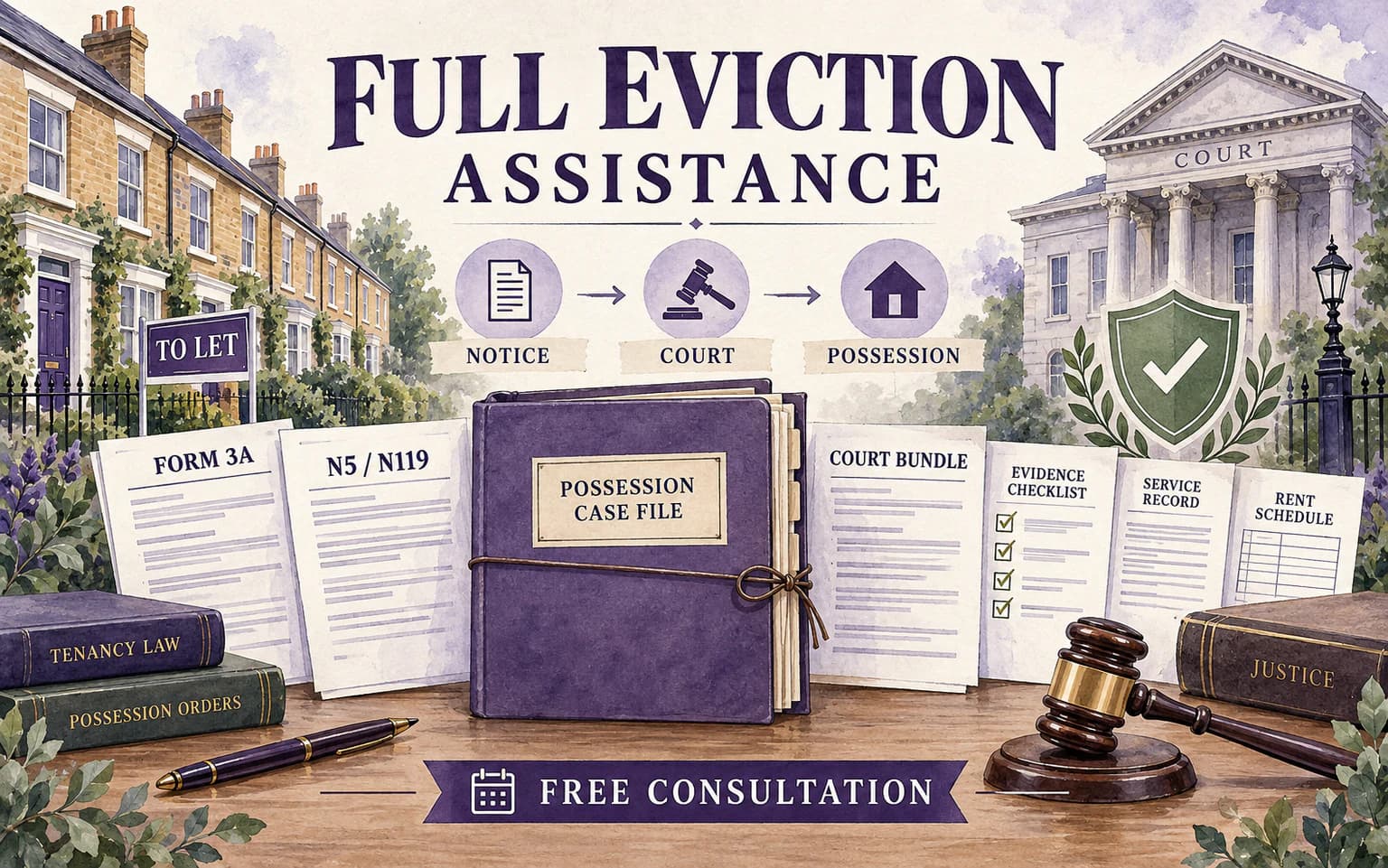
Full eviction case assistance
For landlords who want the Section 8 notice plus N5, N119, service record, evidence bundle and court-stage file prepared together.
Book a free consultation · £399.00What to do next
Core eviction guides landlords usually need next
These are the core possession guides landlords usually need after notice or arrears problems start.
FAQs for landlords

Have a landlord question?
Ask Heaven is our free AI assistant that can help with eviction advice, tenancy questions, and more.