
Rated4.8/5 | 3008 reviews
Section 8 Ground 7 Explained: Death of Tenant (England)
Ground 7 allows possession when the original tenant has died and proceedings are brought within 12 months. Learn succession rights, timing, and the court pro...
Assisted prep
Need help preparing your Section 8 notice?
Start with a free consultation. If suitable, we can help prepare the Form 3A notice, service record and supporting evidence before you serve it.
Book free consultationUse this guide when
You need a practical landlord answer, not just a definition
Use this page when you need to understand section 8 ground 7 death tenant in landlord terms, check the evidence or compliance points that matter, and decide whether the next step is a guide, free tool, notice pack, court pack, tenancy agreement, rent increase pack, or money claim route.
Your tenant is breaching the tenancy and you need to know whether Section 8 notice guide is the right route. This guide explains how it works, what evidence matters, and what to do next.
What landlords should do next
If you are under pressure, decide the route early. In England after 1 May 2026, Section 21 is no longer the live route for new cases. If this ground fits, the next step is using the current Form 3A process with the right evidence and timing.
Need to act on an England possession ground now?
For post-1 May 2026 England cases, Section 21 has gone and the live route is the Form 3A possession notice. Choose the product that matches how far the case has gone.
- Eviction Notice Generator for the Form 3A notice, service instructions, validity checklist, compliance declaration, and arrears statement before you serve anything.
- Complete Eviction Pack if you want the notice, N5, N119, evidence checklist, witness material, and possession file working together from the start.
- Section 8 guide if you want the rule overview first.
- Ground-specific guides: Ground 1 occupation, Ground 1A sale, Ground 2 mortgagee sale, Ground 7A serious ASB, Ground 8 arrears, Ground 10 arrears, Ground 11 late rent, Ground 12 breach, Ground 13 property deterioration, Ground 14 ASB, Ground 15 furniture, and Ground 17 false statement.
Sensitive Situation
The death of a tenant is a sensitive matter. While landlords need to manage their properties, handling these situations with compassion is important. The law provides a reasonable process that respects both property rights and human circumstances.
What Is Ground 7?
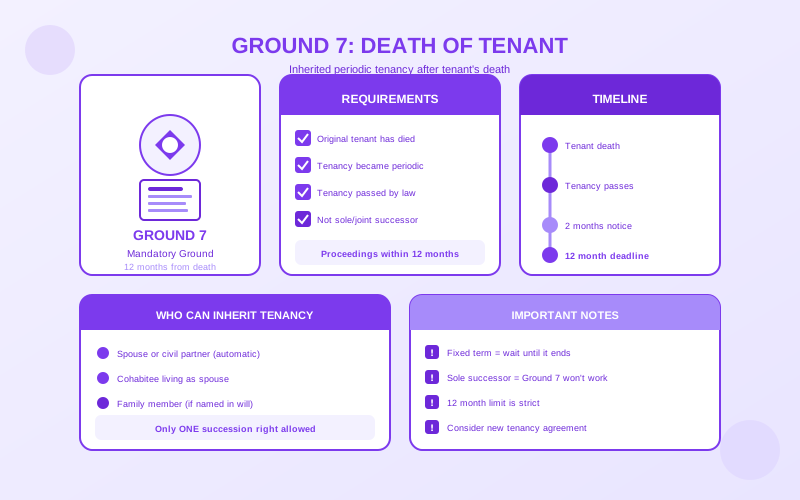
Ground 7 is set out in Schedule 2, Part II of the Housing Act 1988. It applies where:
Next step for landlords
Problem clear? Create the right notice before you serve
If the issue now points toward possession, move from guidance into a notice route that keeps grounds, dates, service, and evidence together.
- Choose the right route before you serve anything.
- Answer plain-English questions. We handle the legal logic.
- Preview the paperwork before you pay.

"The tenancy is a periodic tenancy (including a statutory periodic tenancy) which has devolved under the will or intestacy of the former tenant and the proceedings for the recovery of possession are begun not later than twelve months after the death of the former tenant..."
Key Elements
- Periodic tenancy: Ground 7 applies to periodic tenancies (including ASTs that became periodic)
- Devolution: The tenancy passed to someone through will or intestacy
- No succession: The new occupier didn't succeed to the tenancy under the Housing Act
- 12-month limit: Proceedings must start within 12 months of death
Ground Details
- Type: Discretionary (court considers reasonableness)
- Notice period: 2 months minimum
- Applies to: Periodic tenancies only
Understanding Succession Rights
Before using Ground 7, understand whether someone has succeeded to the tenancy under the Housing Act 1988:
Who Can Succeed?
Under an assured tenancy (including AST), the tenant's spouse or civil partner can succeed if they were occupying the property as their only or principal home immediately before the tenant's death.
Only One Succession
Only one succession is allowed under the Housing Act 1988. If the deceased tenant was already a successor (inherited the tenancy from someone else), no further succession can occur.
Cohabitees and Family
Unlike Rent Act tenancies, there is no automatic succession right for cohabitees or family members under assured tenancies. However, the tenancy may pass to them through the will or intestacy—but this is devolution, not succession, and Ground 7 can apply.
Succession vs. Devolution
Succession gives the new tenant full rights under the Housing Act—Ground 7 doesn't apply. Devolution (through will or intestacy) passes the tenancy but without the same protections—Ground 7 can apply.
The 12-Month Time Limit
Ground 7 has a strict 12-month time limit:
When Does the Clock Start?
The 12-month period begins from:
- The date of the tenant's death, OR
- If later, the date the court accepts that the tenant died (where death date is uncertain)
What Must Happen Within 12 Months?
You must begin proceedings within 12 months—this means issuing the court claim, not just serving notice. Work backwards:
- Issue court claim within 12 months of death
- Serve Section 8 notice at least 2 months before issuing claim
- Investigate succession rights before serving notice
What If You Miss the Deadline?
If 12 months pass without proceedings, Ground 7 is no longer available. You may still have other options:
- Another current possession ground, if the facts support it
- Other Section 8 grounds if applicable (e.g., rent arrears)
Using Ground 7
Step 1: Confirm No Succession
Establish whether anyone has succeeded to the tenancy under the Housing Act. Ask:
- Was the deceased tenant married or in a civil partnership?
- Did the spouse/civil partner live there as their main home?
- Was this already a succession?
Step 2: Identify Current Occupiers
Find out who is living in the property and their relationship to the deceased. They may have inherited the tenancy through the will or intestacy.
Step 3: Serve Section 8 Notice
Serve Form 3 (Section 8 notice) specifying Ground 7. Give at least 2 months' notice. The notice goes to whoever is occupying the property—the "personal representatives" of the deceased or any other occupier.
Step 4: Issue Court Proceedings
Use Form N5 (standard possession). Remember to issue within 12 months of the death date.
Step 5: step-by-step UK eviction process
At the hearing, you must prove:
- The original tenant has died
- No one has succeeded under the Housing Act
- Proceedings were begun within 12 months
- The tenancy was periodic (not fixed-term)

Practical Steps After a Death
When you learn a tenant has died:
Immediate Actions
- Express condolences: Handle the situation sensitively
- Secure the property: If empty, ensure it's safe
- Document everything: Note the date you learned of the death
Within First Month
- Identify who is occupying the property
- Research succession rights
- Contact the tenant's family or personal representatives
Key Decisions
- Do you want to offer a new tenancy to the occupiers?
- Are there rent arrears to address?
- Will you pursue possession under Ground 7?
Timeline Awareness
Keep track of the 12-month deadline. Mark it in your calendar. If you decide to pursue Ground 7, allow time for the notice period (2 months) and court processing.
Consider All Options
Before pursuing eviction, consider whether offering a new tenancy to existing occupiers makes sense. They may be good tenants who have been paying rent. A new AST gives you a fresh start with proper documentation.
Ground 7 FAQ
What if the tenant's spouse still lives there?
If the spouse or civil partner was living there as their main home, they have likely succeeded to the tenancy under the Housing Act. Ground 7 doesn't apply to successors—they have the same rights as the original tenant.
Can I use Ground 7 for a fixed-term tenancy?
No. Ground 7 only applies to periodic tenancies. If the tenant died during a fixed term, the tenancy continues until the term ends (and becomes periodic), at which point Ground 7 could apply if still within 12 months of death.
Who do I serve the notice on?
Serve the Section 8 notice on the current occupiers. If you know the personal representatives (executors of the will or administrators), serve them too. If you don't know who's there, investigate before serving.
What about rent arrears from before death?
Rent owed before death is a debt of the estate. You may be able to claim from the estate through probate. Rent owed after death by occupiers who don't succeed may be claimed from them directly or as a money claim for unpaid rent alongside possession.
Is Ground 7 mandatory or discretionary?
Discretionary. Even if you prove the ground, the court considers reasonableness—the circumstances of the occupiers, impact of eviction, your needs, etc. Courts generally grant possession if there's no good reason to refuse.
What if I want the tenant's family to stay?
You can offer them a new tenancy agreement. This is often the simplest solution—it creates a fresh contractual relationship with proper documentation and may avoid the need for any proceedings.
Handle Complex Situations
Death of a tenant situations require careful handling. Our eviction packs include Section 8 notices and guidance for Ground 7 cases. For complex succession issues, consider professional legal advice.
Get Section 8 Notice ?A clearer route from ground to possession
What to prepare for Section 8 Ground 7
Keep the reason for possession, the notice, proof of service and later court evidence consistent from the outset. Choose the route that matches what you need to do next.
Match the facts
Use the ground only where your evidence supports the reason you will give.
Prepare and serve
Check the notice details, timing and service record before you send anything.
Keep the file joined up
Store the notice, service proof and supporting documents for any court stage.
Choose your document route
Start at the stage your case is actually in

Stage 1: serve the Section 8 notice
£39.99Choose this route when your immediate job is preparing Form 3A and a clear service record before anything is sent to the tenant.
- Problem it solves
- It keeps the ground, tenant details, notice date and service evidence in one notice-stage file.
- Risk if this is not the right stage
- If the tenant stays, you will still need to prepare the court claim file at the next stage.
- Landlord outcome
- You have a structured notice and service route ready to review, approve and serve yourself.

Stage 2: build the full possession file
£69.99Choose this route when you want the Section 8 notice and the court-stage forms, evidence structure and hearing prompts planned together.
- Problem it solves
- It avoids building the notice file first and then trying to reconstruct the same facts for court later.
- Risk if this is not the right stage
- If you only need to serve notice now, this may be more preparation than your case needs today.
- Landlord outcome
- You can prepare one joined-up file for notice, N5, N119, evidence and the court stage.
Prefer us to prepare it with you?
Start with a free consultation before any paid work is agreed
Tell us what has happened and show us the documents you have. We confirm whether assisted preparation is suitable, explain the scope, and only then send a secure payment link.
Section 8 notice assistance
For landlords who need the Form 3A notice, service plan and evidence prompts checked before serving.
Book a free consultation · £149.00
Full eviction case assistance
For landlords who want the Section 8 notice plus N5, N119, service record, evidence bundle and court-stage file prepared together.
Book a free consultation · £399.00What to do next
Core eviction guides landlords usually need next
These are the core possession guides landlords usually need after notice or arrears problems start.
FAQs for landlords

Have a landlord question?
Ask Heaven is our free AI assistant that can help with eviction advice, tenancy questions, and more.